
Seoul Fashion Week collections are consistently described in European fashion media as oversized, deconstructed, or gender-neutral. All three descriptions are approximately correct and almost entirely wrong — because they apply European silhouette grammar to a design language built on different structural premises.
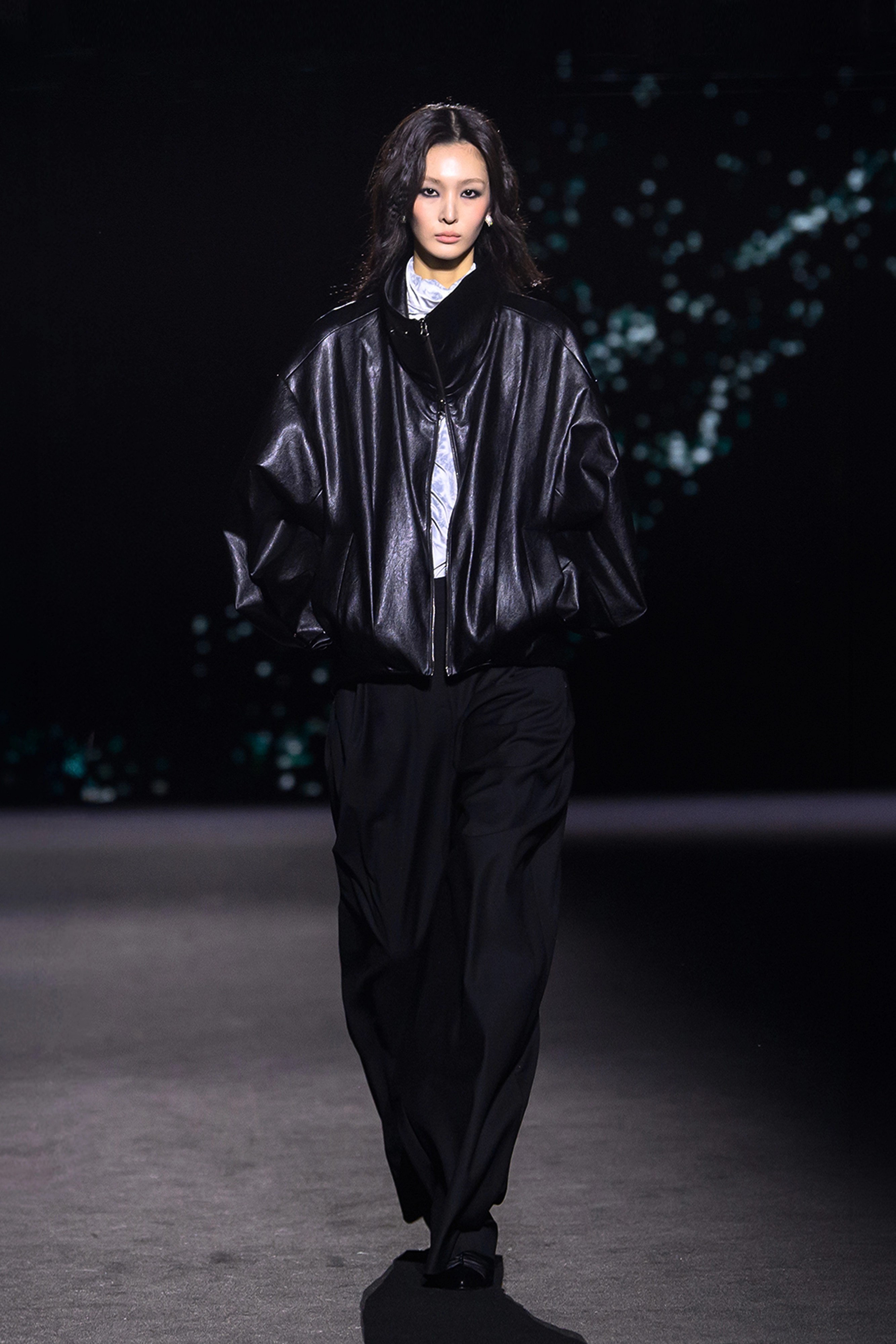
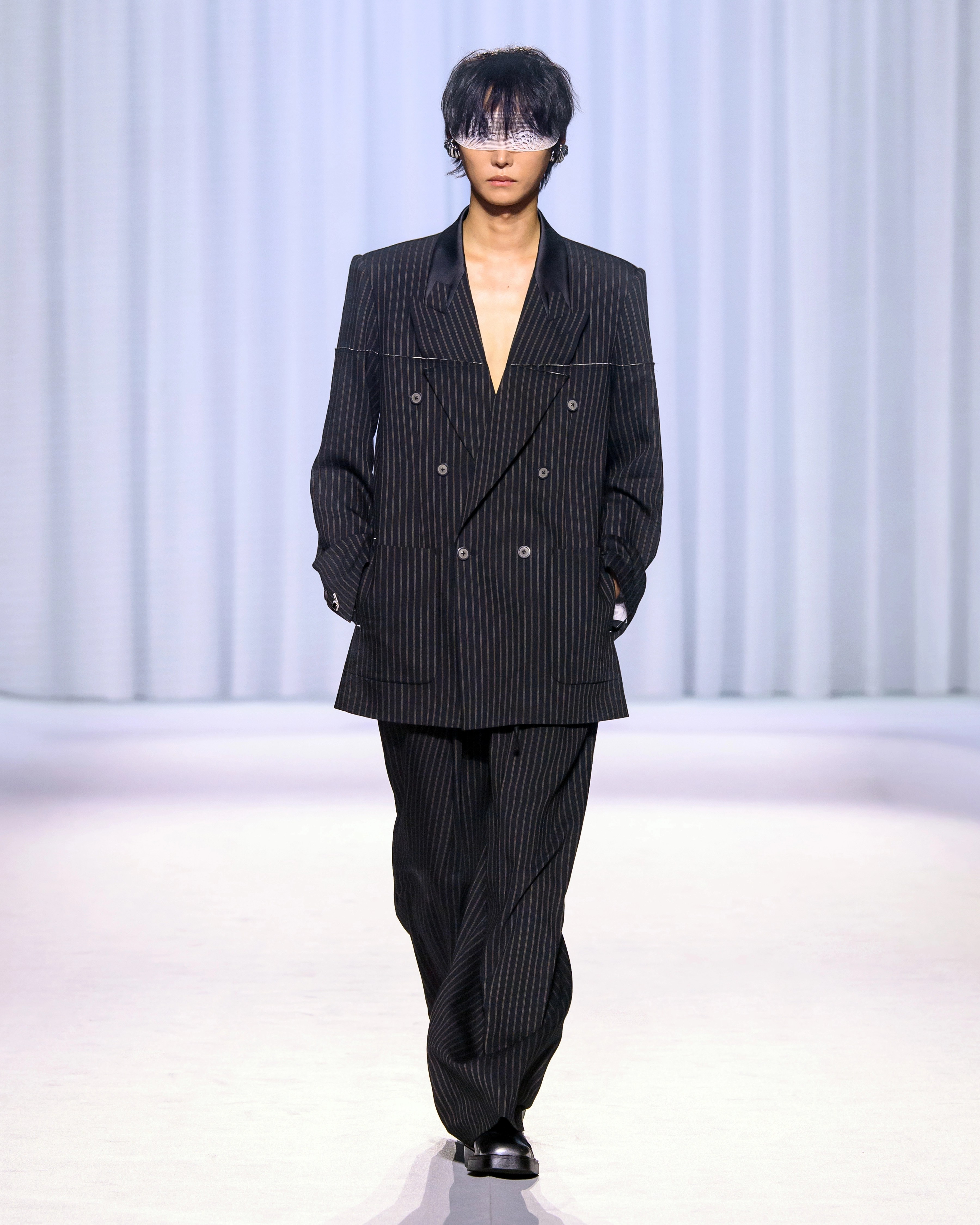
The confusion begins with vocabulary. When European fashion criticism encounters a Seoul collection with wide, unstructured shoulders, dropped sleeves, and a hemline that breaks at an unconventional point, the instinct is to file it under the visual category closest to hand — oversized, a term that means “larger than body-fitted.” But oversized, as a description, contains a normative assumption: that body-fitted is the default from which the garment departs. Korean fashion does not share that default. It is not departing from a fitted norm. It is working within a structural tradition in which the relationship between garment volume and body volume has always been governed by different rules.
Seoul Fashion Week, which runs biannually in March and October, has grown significantly in international visibility since the mid-2010s. The Korean Fashion Association (한국패션협회) and the Seoul Metropolitan Government jointly administer the event, which now routinely draws international press, buyers, and designers. The collections shown at SFW represent a range of aesthetic positions — from highly commercial ready-to-wear to experimental conceptual work — but across that range, a set of structural preferences recur with enough consistency to constitute a recognisable design language. Understanding that language requires disengaging from European proportion norms before engaging with Korean ones.
This is not a cultural sensitivity point. It is a design analysis point. The silhouette choices made at SFW follow a coherent internal logic. That logic has roots in Korean dress history, is reinforced by contemporary Korean fashion education, and produces garments whose structural decisions become legible once the underlying proportion system is understood. The goal here is to make that system legible — not to celebrate it generically, but to analyse it precisely.
Seoul Fashion Week — the structural context
SFW’s current format consolidates multiple schedule tiers — HERA Seoul Fashion Week (the main runway programme), Generation Next (emerging designers), and the trade show element — into a week-long event held at Dongdaemun Design Plaza (DDP), Zaha Hadid’s undulating structure in central Seoul that has become an architectural emblem of the city’s design ambitions. The DDP venue is not incidental: its curved, continuous surface and rejection of orthogonal geometry provide a structural counterpoint to the kind of rigidly constructed garments that would look incongruous against it. The environment asks for a different kind of volume.
Korean fashion education provides a more specific structural explanation. The major fashion programmes — at Hongik University, Ewha Womans University, Seoul National University, and the Korean Academy of Fine Arts — have, over the past two decades, increasingly integrated Korean dress history and traditional textile knowledge into their design curricula. This is not costuming. It is pattern-making instruction: students learn how the hanbok’s construction logic — flat pattern pieces assembled into volume through dart suppression and seam placement rather than through dart introduction — produces three-dimensional form differently from the Western tailoring tradition. That learning enters the collections.
Proportion as argument — what Korean silhouette is actually doing
The operative concept in Korean fashion proportion is not size — it is ratio. Specifically, the ratio between the width of the garment at the shoulder plane and the width at the hip plane, and the position of the visual weight centre along the vertical axis. European tailoring, across its dominant tradition from Savile Row to Italian sartorial, locates visual weight at the shoulder (structured, padded) and tapers toward the hip and hem. The body is read as a triangle with apex at the shoulder. Volume, when it appears in this tradition, is typically additive — the triangle gets wider — but the apex remains at the shoulder.
Korean fashion as practised at SFW tends to relocate visual weight. The shoulder plane is often softened or dropped, reducing its role as the visual apex. Volume accumulates instead at the mid-torso, the sleeve, or the hem. The silhouette reads not as a widened triangle but as a rectangle — or, in the most assertive cases, as an inverted trapezoid with the widest point below the waist. This is a structural decision about where the garment’s visual argument lives, not an absence of argument.
Seoul collections are not departing from a fitted norm. They are working within a different proportion system — one in which volume is a structural tool, not a stylistic gesture.
The practical consequence is that Korean garments often read as flat in photographs and dimensional in movement. The European fitted silhouette is designed to communicate proportion in a static photograph — the body’s shape is evident at a glance. The Korean volume silhouette is designed to communicate proportion through time — how the fabric moves, settles, and layers as the wearer moves through a space. This is a different design brief, optimised for a different viewing condition.

The hanbok inheritance — straight cut, negative space, layered plane
The hanbok (한복, 韓服) is the category of traditional Korean dress with the longest continuous development. Its construction logic differs from European dress construction in three significant ways that are directly relevant to understanding contemporary Korean fashion silhouette.
First, the hanbok is built on straight-cut pattern pieces. The jeogori (저고리), the upper garment, consists largely of rectangular fabric pieces with minimal curve cutting. Shaping is achieved not through dart introduction — the standard European method for converting flat fabric into three-dimensional form — but through the manipulation of seam angles and the use of the fabric’s own drape. The result is a garment that creates volume without constriction: the body occupies space inside the garment rather than being shaped by it.
Negative space as design element: The space between body and fabric is treated as part of the garment’s form. In the chima (치마, skirt), the volume of the skirt relative to the body creates the silhouette — not the body’s shape. The body is present inside the silhouette but does not define its outline. This is a fundamentally different relationship between body and garment than the European model.
Layered plane: Hanbok is structurally layered — jeogori over chima, with the layers visible at overlapping edges. Each layer is a distinct plane. Contemporary Korean designers frequently translate this into multi-layer silhouettes in which each fabric plane has its own proportion and trajectory, creating what reads in European terms as complexity but is, structurally, a simple layering logic applied consistently.
Second, the hanbok treats negative space — the volume between body and fabric — as a design element in its own right. The chima (치마), the skirt element, achieves its silhouette through fabric volume, not body shape. The body is present inside the silhouette, but does not define its outline. European fitted dress, by contrast, uses fabric as a skin — the silhouette should communicate the body’s shape beneath it. These are structurally opposite approaches to the relationship between garment and body.
Third, the hanbok is layered — jeogori over chima, with visible edges at the overlap — and each layer is treated as a distinct visual plane. Contemporary Korean designers frequently deploy this multi-plane logic at scale: a collection may feature a series of pieces in which each component of a look occupies a different spatial plane, with deliberate visual separation between them. This is not eclectic styling. It is the layered-plane logic of traditional Korean dress applied to contemporary silhouette.


Seoul vs Paris and Milan — a structural comparison
The contrast between SFW’s structural logic and that of Paris and Milan collections is clearest when observed across four specific variables: the location of visual weight, the relationship between garment and body, the role of movement in the silhouette’s design brief, and the treatment of fabric as surface versus fabric as volume. The table below organises this comparison without hierarchy — neither system is technically superior; they are structurally distinct.
| Design variable | Seoul Fashion Week | Paris / Milan dominant tradition |
|---|---|---|
| Visual weight location | Mid-torso, sleeve, hem — variable by collection | Shoulder (tailoring) or hip (draped) — tradition-dependent |
| Garment–body relationship | Garment volume independent of body shape; body occupies space inside the silhouette | Garment communicates body shape; fabric as second skin or body amplifier |
| Design brief | Optimised for movement and time; silhouette communicates proportion through motion | Optimised for static photography and fitting-room readability |
| Pattern logic | Straight-cut or minimal-dart pieces; shaping through seam angle and drape | Curved seams and dart-based shaping; three-dimensionality built into flat pattern |
| Layering treatment | Multiple discrete planes; each layer has independent proportion and trajectory | Layering typically subordinate to primary silhouette; layers amplify rather than multiply planes |
| Fabric as surface vs volume | Fabric as volume — air space between body and fabric is part of the form | Fabric as surface — the cut shapes fabric closely or loosely but the surface remains the primary element |
Volume is not excess. It is the designed space through which the body moves. The silhouette exists independently of the body inside it — the two are in dialogue rather than coincidence.
The dropped or unstructured shoulder is not a relaxed shoulder. It is a shoulder whose role as visual apex has been deliberately reassigned — often to the sleeve mass or to the horizontal plane of a wide hem.
Layering is structural, not stylistic. Each plane in a look is a distinct design unit with its own proportion. The look is a composition of planes, not a base with additions.
The body’s shape is the brief. Whether through tailoring (amplifying the body’s geometry) or draping (following its surface), the garment is in a representational relationship to the body beneath it.
The structured shoulder is the visual apex of a triangular silhouette. Volume below the shoulder is legible in relation to this apex — it tapers, extends, or contrasts, but always references the shoulder as origin.
Layering amplifies a primary silhouette. The outermost layer is the silhouette; inner layers provide texture, warmth, or styling interest, but do not compete for independent visual plane status.
Three designers, three structural positions
The structural logic described above is not uniform across SFW — it is a tendency, not a rule. Three designers currently working within the Seoul fashion system illustrate different positions within this tendency and clarify its range.
Wooyoungmi (우영미)
Wooyoungmi, who shows in both Seoul and Paris, represents the most direct translation of Korean proportion logic into a European luxury context. Her menswear consistently uses a dropped-shoulder construction that rejects the Savile Row apex without abandoning tailoring discipline entirely. The jacket remains structured — there are canvassing, seam precision, and material quality that place it firmly in the luxury tailoring category — but its visual weight lives at the chest and sleeve, not at the shoulder point. European buyers initially read this as “relaxed tailoring,” a term that misses the point: the shoulder is not relaxed. It is structurally repositioned.
Münn (뮌)
Münn, helmed by Hyun-min Han (한현민), operates at a more experimental register, using volume as a spatial medium rather than a clothing component. Münn silhouettes frequently create significant negative space between garment and body — proportions that, in European terms, would read as scale error but, within the hanbok-derived logic of the garment as an independent form, are internally consistent. What appears excessive at a glance resolves, in movement, into a coherent spatial proposition.
Juun.J (준지)
Juun.J, showing at Paris Fashion Week, provides the clearest case of the layered-plane logic applied at a high-profile international context. His collections are consistently built on multiple fabric planes — a coat over a jacket over a shirt, each with its own proportion and each visible at the edges. European critical reception tends to describe this as “maximalist,” but the term is misleading: the look is composed of simple elements, each with a straightforward silhouette. The complexity comes not from within any individual piece but from the relationship between planes — a compositional logic that is structurally distinct from European maximalism’s tendency toward surface elaboration.
Why this matters for European designers
The structural literacy gap between Korean and European fashion design is not primarily a consumer problem — audiences can enjoy collections without understanding their structural logic. It is a professional problem for European designers, buyers, and editors who work in contexts where Korean fashion is increasingly referenced, collaborated with, or competing for the same market positions.
The misreading of Korean silhouette as “oversized” has practical consequences. It produces European interpretations that add volume without repositioning visual weight — garments that are wide rather than structurally reorganised. It produces editorial styling that treats Korean proportion pieces as casual wear because their shoulder structure reads as informal by European tailoring standards. And it produces buyer decisions that underestimate the construction complexity of pieces that appear simple but are built on sophisticated pattern logic.
For European designers who are actively drawing on Korean references — and this is an increasing category, given the consistent critical and commercial attention SFW has received since the late 2010s — the more productive engagement is with the proportion system itself rather than with its visible outputs. The goal is not to reproduce Korean silhouette but to understand the structural premises that generate it, and to engage with those premises on their own terms.

Working across product development in Korea and London for fifteen years, and now based in Berlin, I have had the opportunity to observe the translation problem at close range — both the Korean designer pitching to European buyers who cannot parse the proportion logic, and the European designer drawing on Korean references without understanding the structural system that generates them. The mismatch is almost never about aesthetic preference. It is about structural literacy. A European buyer who reads a Münn look as a sizing error and a Korean designer who cannot explain why the shoulder is where it is are both operating without the relevant grammar.
The German design context is particularly instructive as a comparison case. German fashion design — through institutions like the Weissensee Kunsthochschule and the Berlin design scene more broadly — has a strong tradition of structural rigour: garments are understood as constructed objects with explicit structural logic, and that logic is expected to be defensible. This is, in principle, a reading framework that should be capable of engaging with Korean fashion’s structural premises. In practice, the engagement often stalls because the reference library is European — the structural comparisons on offer are to Comme des Garçons, to Margiela, to Rick Owens. Korean fashion’s structural tradition is simply not in the curriculum in a way that would allow the comparison to be made accurately.
The most productive conversations I have observed between European and Korean designers are those in which the Korean designer explains the pattern — literally, the flat pattern piece — and the European designer looks at it and recognises a construction logic that is coherent but different. At that point, the translation becomes possible. The vocabulary of pattern construction is more transferable across design traditions than the vocabulary of aesthetic description, and it gets to the structural question more directly than any discussion of silhouette or proportion abstracted from the object that produces it.
References
- Seoul Fashion Week Official — programme archive and designer profiles. sfw.or.kr
- Korea Craft & Design Foundation (KCDF) — Korean design analysis and material culture documentation. kcdf.kr
- Korea Institute of Design Promotion — DesignDB, Korean design trend research. designdb.com
- National Folk Museum of Korea (국립민속박물관) — hanbok construction and traditional dress history. nfm.go.kr
- Dezeen — Korean Design coverage. dezeen.com
- Geum, Key-Sook (금기숙). Korean Traditional Costume. Korea Foundation, 2005.
- Chang, Dong-ho (장동호). “Structural characteristics of hanbok pattern construction and their application in contemporary Korean fashion design.” Journal of the Korean Society of Costume, Vol. 68, No. 3, 2018.
- KIA Design Magazine — Korean design philosophy and CMF analysis. kiadesignmagazine.kia.com



Leave a Reply