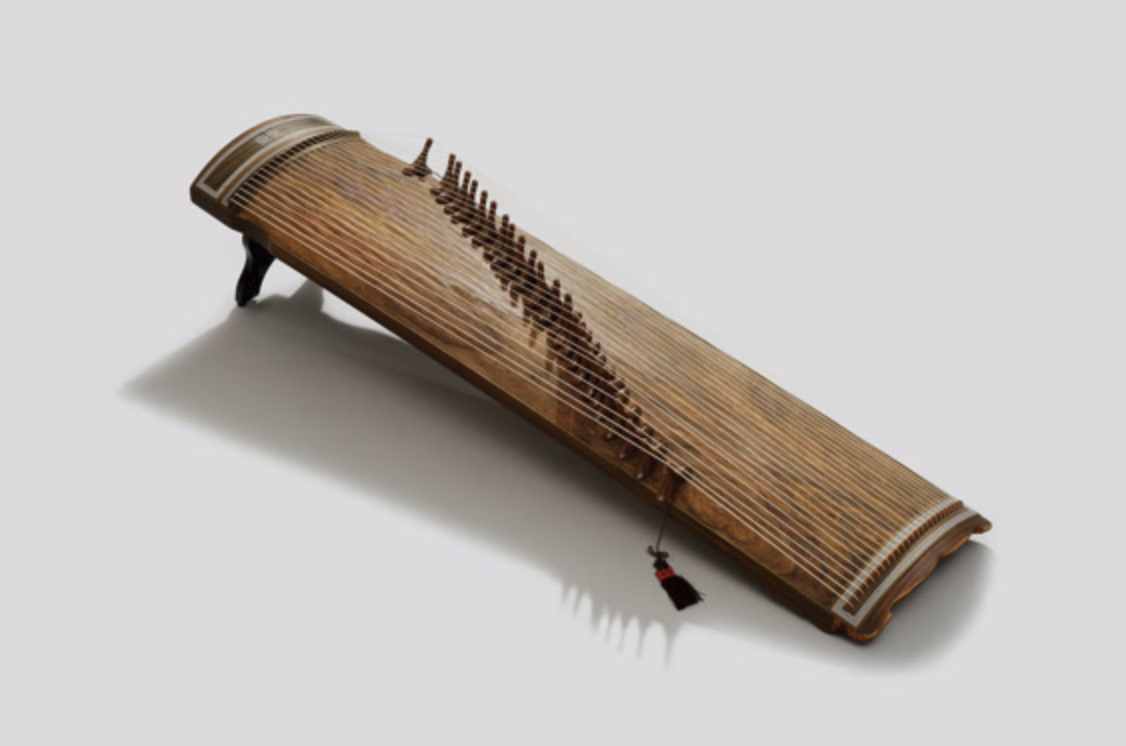
The gayageum’s silk strings do not sustain. They decay. A plucked note on the gayageum is already diminishing at the moment it begins — which is not an acoustic limitation but a design principle that encodes a specific relationship between sound, time, and silence.
The gayageum (가야금, 伽倻琴) is a Korean plucked zither with twelve to twenty-five strings (traditionally twelve), played by plucking with the right hand while the left hand presses and vibrates the strings above a moveable bridge to produce pitch variation and ornamental flourishes. It functions as both the central melodic instrument of Korean court music (jeongak, 정악) and a solo concert instrument, and carries the primary repertoire of Korean instrumental classical music. The European parallel most commonly drawn is the harp or the Japanese koto, though the comparison breaks at the instrument’s treatment of decay as musical material — gayageum technique actively shapes the sound’s diminution rather than sustaining or suppressing it.
Designated as National Intangible Cultural Heritage No. 23, the gayageum traces its origins to the Gaya confederacy (42–562 CE). The National Gugak Center (국립국악원, Seoul) maintains the primary institutional record of gayageum repertoire and performance standards.
The gayageum is usually introduced to non-Korean audiences through the history of its origin legend — the Gaya king Gasil commanded the musician Ureuk to compose twelve pieces for a newly constructed instrument, referencing the twelve months of the year. This origin story is worth noting not for its historical reliability (it comes from the twelfth-century Samguk Sagi, compiled centuries after the fact) but for what it encodes: the instrument’s number of strings was deliberate, numerologically considered, and tied to a cosmological framework rather than determined by acoustic optimisation. The gayageum was designed as a culturally meaningful object before it was a musical instrument in the purely acoustic sense.
This is the entry point for understanding the gayageum’s design logic. The instrument’s choices — silk over metal strings, moveable bridges (안족, anjok) over fixed, the specific body dimensions that produce its characteristic resonance decay — are not technical compromises or historical accidents. They are decisions about what kind of sound is worth making and what relationship between musician and instrument is desirable. Those decisions are coherent and consistent across the instrument’s long history, which suggests they reflect something stable in Korean musical aesthetics rather than arbitrary convention.
Silk strings and the physics of decay
The gayageum’s traditional strings are made from twisted silk fibres. Steel-string versions of the gayageum exist and are common in contemporary performance, but the traditional silk-string instrument produces a sound quality that differs fundamentally from steel in its temporal profile: silk strings have lower tension and greater internal damping than steel, which means the vibration of a plucked silk string decays more rapidly and at a different rate across the frequency spectrum. High frequencies (the attack transient, the initial brightness of the pluck) decay fastest; lower frequencies sustain longer. The resulting sound envelope has a fast attack followed by a gradual darkening and softening as the note progresses.
This decay profile is not incidental — it is what gayageum performance technique is built around. The left-hand technique (눌러내기, nulleonaegi — pressing; 퇴성, toegseong — releasing; 추성, chuseong — sliding upward) shapes the pitch and character of the note during its decay, not at its onset. The right hand plucks; the left hand works with what follows. This is structurally different from piano technique, in which the note’s character is determined at the moment of key depression and the performer has no further influence over it. In gayageum playing, the note is a process rather than an event.
The gayageum note does not sustain and then end. It changes throughout its duration — and the quality of that change, managed by the left hand, is where the music lives.
Left-hand technique — vibrato, press, and the ornament as structure
Korean traditional music theory distinguishes between 음 (eum, the pitch in the abstract sense) and 소리 (sori, the sound as physically produced and shaped). This distinction is philosophically significant: it implies that the pitch is not the sound, and that what matters musically is not primarily the pitch content but the quality of the sound through which the pitch is expressed. Left-hand gayageum technique is the primary mechanism by which sori is produced from eum — by which the abstract pitch is given its specific physical character.
The main left-hand ornamental techniques are: 농현 (nonghyeon) — a vibrato produced by oscillating the string above the bridge, varying in speed and depth to produce different emotional qualities; 퇴성 (toegseong) — a pitch release from a pressed position, moving from a higher to a lower pitch during the note’s decay; and 추성 (chuseong) — a gliding upward pitch inflection applied to the beginning of a note. Each of these is not a decorative addition to a pitch but a modification of the note’s temporal structure. A note played with deep slow nonghyeon is not the same note as one played without nonghyeon — it has a different musical meaning in the tradition’s own terms.
“playing the string”
Aesthetic significance: In Korean music theory, nonghyeon is not ornament in the Western sense — not an addition to a note but a constitutive dimension of it. A note without appropriate nonghyeon is not a correctly performed note; it is technically deficient regardless of its pitch accuracy. The quality of nonghyeon is the primary marker of a performer’s artistry in traditional gayageum evaluation.
Relationship to jeong: Korean music scholarship has connected the quality of nonghyeon — its warmth, its variation, its responsiveness — to the concept of jeong (情): the affective quality of relational feeling. A performer who has deeply internalised jeong in the musical sense plays nonghyeon differently from one who has not, in a way that experienced listeners recognise as a quality of presence rather than technique.
Jeongganbo — the time grid and Korean musical duration
Western musical notation encodes duration through a relative system: a whole note is twice as long as a half note, which is twice as long as a quarter note, and so on. The actual duration of each note is determined by the tempo marking, which specifies how many beats occur per minute. The system is recursive and proportional — duration is defined by its relationship to other durations.
Jeongganbo (정간보, 井間譜) — the traditional Korean notation system developed in the fifteenth century by king Sejong’s court musicians — takes a different approach. The notation divides time into fixed-size cells (정간, jeonggan, literally “well-intervals”) organised in groups that represent rhythmic cycles (장단, jangdan). Each cell represents a fixed unit of time; notes that occupy one cell, two cells, or three cells have durations determined by how many cells they fill. The system represents musical time not as a proportional hierarchy of durations but as a spatial filling of a fixed temporal grid.
Time is divided into fixed-size cells arranged in rhythmic cycles. Duration is determined by how many cells a note occupies — a spatial-fill logic rather than a proportional hierarchy.
The notation system is two-dimensional: pitch is written in the cell (using Chinese characters or Korean notation symbols); duration is represented by the cell’s position and how many cells the notation extends into.
Silence is not separately notated as rests — empty cells represent silence. This means silence and sound occupy the same spatial grid, with equal ontological status as components of the rhythmic cycle.
Duration is encoded as a proportional hierarchy: whole, half, quarter, eighth notes, each half the value of the previous. The actual duration depends on the separately specified tempo marking.
Pitch (vertical position on the staff) and duration (note head shape, stem, beam) are encoded separately but on the same two-dimensional staff. The system is primarily pitch-optimised.
Silence is specifically notated as rests with their own proportional hierarchy. Rests have the same ontological status as notes — both are named durations within a proportional system.
The jeongganbo system’s treatment of silence is its most significant philosophical difference from Western notation. In the Western system, silence is a rest — a named duration that marks the absence of sound. In jeongganbo, an empty cell is not named; it simply is — a time-grid cell that contains no sound. The silence does not need to be labelled because it occupies the same kind of space as sound. It is not the absence of music; it is music without pitch content.
Silence in Korean instrumental music — the yeumak concept
The Korean concept most relevant to the gayageum’s treatment of silence is여음 (yeoeum, 餘音) — the “remaining sound” or “echo” that persists after a note has formally ended. In Korean musical aesthetics, yeoeum is not simply resonance — it is the sonic space after the note in which the note’s meaning is fully received. The gayageum’s decay profile, which produces a gradual rather than abrupt ending, makes this space particularly prominent: the note does not stop, it fades, and in that fading there is a perceptual space for the listener that an instrument with fast decay or hard cutoff does not provide.
This concept connects to a wider Korean aesthetic category — 여백 (yeobaek, 餘白), the productive emptiness or negative space that is a valued quality in visual art, calligraphy, and music simultaneously. In the gayageum context, yeoeum is the temporal equivalent of yeobaek: the space that gives the preceding element its full meaning by not being immediately filled. A skilled gayageum player controls the transition into silence as carefully as they control the note itself — the silence is not waiting for the next note; it is completing the current one.

The gayageum in contemporary Korean music
The gayageum’s contemporary use has bifurcated significantly since the 1970s. The traditional twelve-string gayageum (정악가야금, jeongak gayageum) continues in the court music and sanjo (산조) solo repertoire. The sanjo gayageum, a slightly longer instrument with more string tension developed in the late nineteenth century for the solo improvisation tradition, has become the dominant performance form. And a proliferating range of extended-string gayageums — eighteen, twenty-one, and twenty-five strings, developed by instrument makers and composers working with Korean institutions — has expanded the instrument’s range to enable it to perform contemporary music with chromatic and extended harmonic requirements.
Composers including Isang Yun (윤이상) — who worked between Korean traditional aesthetics and European avant-garde composition — used the gayageum’s specific timbral qualities (the decay profile, the vibrato techniques, the silences) as structural elements in works that combine Korean and European musical languages. Yun’s work represents one of the most rigorously theorised engagements with Korean musical philosophy in a contemporary context: he described his compositional principle of Hauptton (main tone) surrounded by ornamental tones as a translation of the Korean relationship between eum (the abstract pitch) and the living sori (the physical sound that surrounds it).
Gayageum vs European zither traditions — a structural comparison
The gayageum is most commonly compared to the Japanese koto in East Asian music surveys, but the European comparison — to the harpsichord, zither, or harp — is also instructive for what it clarifies about different instrument design philosophies. The European harpsichord, like the gayageum, produces its sound by plucking strings, but its design aims at maximal pitch clarity and minimal post-pluck manipulation: once plucked, the harpsichord string vibrates at its fundamental frequency until damped; the performer cannot influence the note after the key is depressed. The gayageum’s design philosophy is structurally opposite: the instrument is designed so that the performer’s primary expressive work happens in the note’s aftermath.
The European zither family — particularly the concert zither — allows some post-pluck pitch manipulation but within a fixed-pitch system without the moveable bridge that gives the gayageum its characteristic flexibility. The harp allows some glissandi but not the fine pitch manipulation, the pressed vibrato, or the deliberate alteration of decay that constitute the gayageum’s performance language. The instrument most comparable in its emphasis on post-pluck expressivity is arguably the Japanese koto — itself descended from the same Chinese zheng source as the gayageum — though the Korean and Japanese traditions have developed distinct ornamental systems and distinct relationships to silence.
The Korean traditional music sector has been engaged in a sustained debate since at least the 1970s about what constitutes authentic gayageum performance and who has authority to define it. The National Gugak Center and the Cultural Heritage Administration’s designation system for intangible cultural heritage have created a formal hierarchy of authorised practitioners, which has had the practical effect of privileging specific regional and pedagogical lineages of sanjo gayageum playing as the standard against which other approaches are evaluated. Critics within the Korean music community — particularly composers and performers working in contemporary crossover contexts — argue that the designation system has transformed a living, evolving tradition into a museum object, prioritising historical fidelity over the creative adaptation that has always driven the tradition’s development.
The extended gayageum debate is particularly sharp: instrument makers and composers who develop twenty-one and twenty-five string versions argue that instrument development is a natural continuation of the tradition (the sanjo gayageum itself was a nineteenth-century development, not the original instrument). Heritage designation advocates argue that extending the string count fundamentally changes the instrument’s acoustic and aesthetic character in ways that sever continuity with the tradition being preserved. Neither position is wrong — they represent genuinely different theories of what a tradition is and what preservation requires. The Korean music community’s inability to resolve this debate reflects a real tension between two equally legitimate goods: the integrity of specific historical practice and the vitality of living artistic development.
My engagement with gayageum came through a detour — not through music education but through material design. Working on a packaging project that needed to encode Korean aesthetic principles for a European luxury audience, I was introduced to the concept of yeoeum by a Korean musicologist who was serving as a cultural consultant on the project. The idea that the space after a sound is not empty — that it carries the completion of the sound’s meaning — gave me a framework for thinking about packaging that I had not had before. In Western design, negative space is treated as rest: the absence of visual content that allows other content to be read more clearly. In Korean aesthetic theory, the empty space is not resting from anything; it is doing something specific. That distinction changed how I thought about unprinted white space on packaging — not as visual breathing room but as material that carries its own argument.
In Berlin, the gayageum has found a small but real audience through the city’s experimental music scene — several Korean musicians working in the city have been doing sustained work with the instrument in improvisation and composition contexts that position it in dialogue with European free jazz and contemporary classical music. What is interesting about these performances is that the non-Korean audiences who engage most deeply with them tend not to be classical music consumers but experimental and ambient music listeners — people whose sonic sensibility has already been trained toward appreciating decay, silence, and gradual transformation as musical material. The gayageum’s aesthetic finds natural resonance not with European classical music audiences, who tend to evaluate it against the wrong criteria, but with audiences whose relationship to sound is already built around the kinds of temporal values the instrument embodies.
Frequently Asked Questions
What is the gayageum and how old is it?
The gayageum (가야금, 伽倻琴) is a Korean plucked zither with twelve traditional strings (modern versions have up to twenty-five), played by plucking with the right hand while the left hand shapes pitch and tone quality by pressing and vibrating the strings above moveable bridges. Its origin is attributed to the Gaya confederacy (42–562 CE), making it one of the oldest continuously practised instruments in East Asia. It is designated National Intangible Cultural Heritage No. 23 and is the central instrument of Korean court and traditional solo music.
How does the gayageum differ from the Japanese koto?
Both instruments are members of the same long-zither family descended from the Chinese zheng, but they have developed distinct performance aesthetics and instrument designs over centuries. The gayageum is slightly smaller, has moveable bridges (anjok) that give each string independent pitch adjustment, and uses silk strings in its traditional form. The koto uses a different bridge system and is associated with a more legato, sustained melodic style. Most significantly, the ornamental technique systems differ: Korean gayageum performance is built around vibrato (nonghyeon) and pitch slides above the bridge, while koto technique emphasises different forms of pitch inflection and a broader range of glissando techniques. The treatment of decay and silence also differs in the two traditions’ aesthetics.
What is jeongganbo and why is it significant?
Jeongganbo (정간보, 井間譜) is the traditional Korean musical notation system developed in the fifteenth century, which represents musical time as a grid of fixed-size cells (jeonggan) rather than as a proportional hierarchy of note values as in Western staff notation. Its significance lies in the different time philosophy it encodes: time is not divided proportionally (double, half, quarter) but spatially filled at a fixed rate. Silence occupies empty cells with the same ontological status as filled (sound) cells — it is not labelled or given a separate notational identity but simply present as the absence of pitch content in a time that continues regardless. This is one of the clearest examples of how Korean aesthetic premises about time and silence differ structurally from European musical notation.
What is nonghyeon and why is it important in gayageum performance?
Nonghyeon (농현, 弄絃 — “playing the string”) is the gayageum’s primary vibrato technique, produced by the left hand oscillating the string above the bridge during a sustained note to create regular pitch variation. Unlike violin vibrato, it is not continuous or uniform — it varies in onset, speed, depth, and fade according to the phrase’s expressive character. In Korean music theory, nonghyeon is not an ornament added to a note but a constitutive dimension of it: a correctly performed note includes appropriate nonghyeon, and its absence or poor quality represents artistic deficiency regardless of pitch accuracy. The quality of a performer’s nonghyeon is the primary criterion by which experienced Korean audiences evaluate their artistry.
How has the gayageum been used in contemporary music?
Contemporary uses of the gayageum span a wide range. Within Korean traditional music, the sanjo (산조) improvisation form remains the dominant contemporary performance context for the traditional instrument. Composers including Isang Yun (윤이상) developed compositional approaches that used gayageum timbral qualities — particularly the decay profile and vibrato system — as structural elements in works engaging both Korean and European musical languages. More recent composers and performers have extended the instrument (to eighteen, twenty-one, and twenty-five strings) and placed it in contexts including electroacoustic composition, free improvisation, and cross-genre collaboration with jazz, ambient, and experimental music. The instrument’s specific acoustic qualities — its decay profile and the prominence of silence in its aesthetic — give it a natural resonance with contemporary experimental music sensibilities.
References
- National Gugak Center (국립국악원). gugak.go.kr
- Academy of Korean Studies (한국학중앙연구원 — AKS). aks.ac.kr
- National Intangible Heritage Center (국립무형유산원). nihc.go.kr
- Howard, Keith. Korean Musical Instruments. Oxford University Press, 1995.
- Lee, Hye-Ku. Essays on Korean Traditional Music. Trans. Robert Provine. RAS Korea, 1981.
- Provine, Robert C. “Jeongganbo.” In New Grove Dictionary of Music and Musicians, 2001.
- Yun, Isang. “Über meine Musik / On My Music.” Translated essays. Berlin: Bote & Bock, 1983.
- Chang, Sa-hun (장사훈). History of Korean Traditional Music (韓國傳統音樂史). Seoul: Sejong University Press, 1982.



Leave a Reply