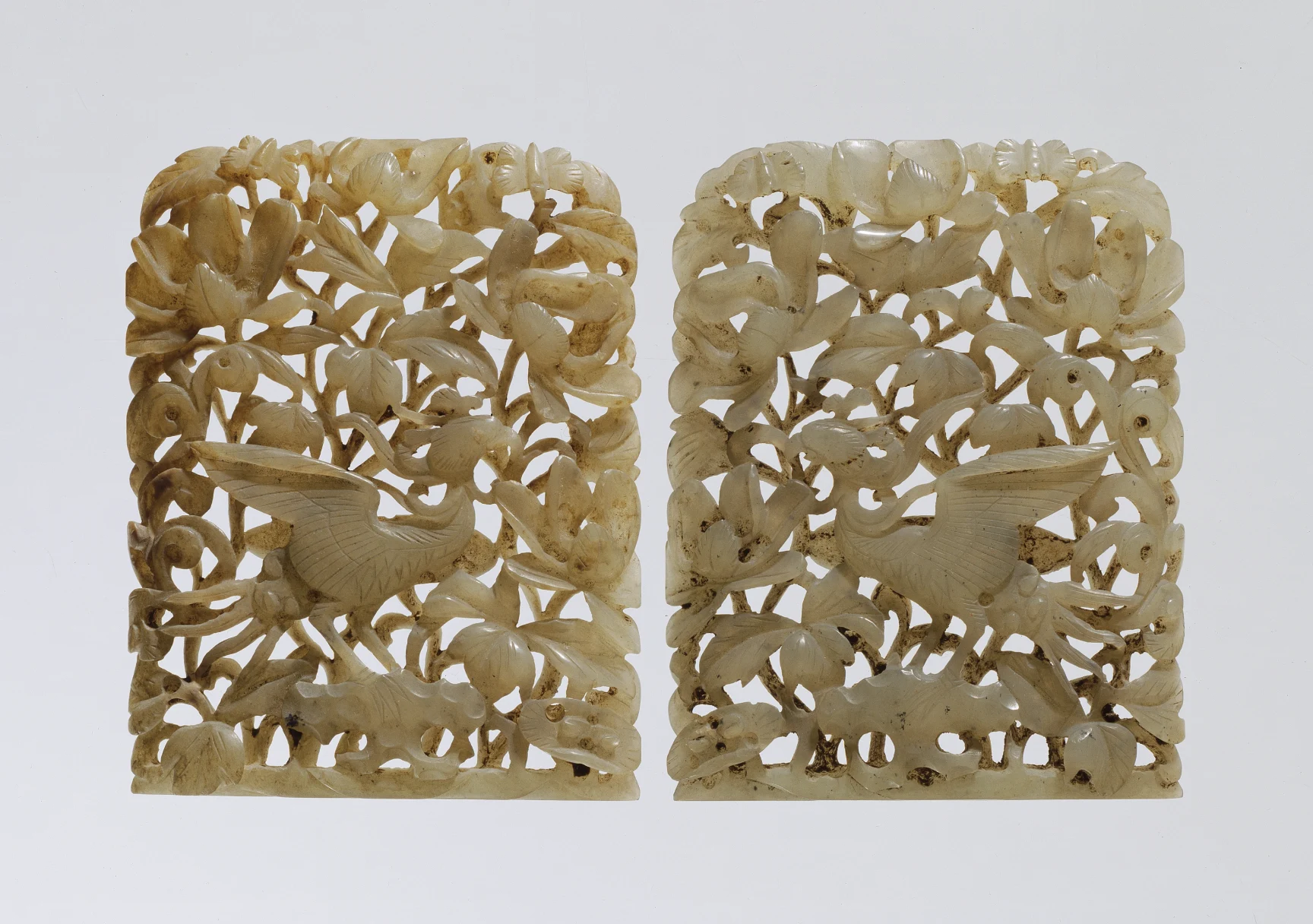
Korean white jade is nephrite, not jadeite. This mineralogical distinction is not a footnote — it is the entry point into a different material philosophy. Nephrite and jadeite are different minerals with different physical properties, different historical distributions, and different roles in the craft traditions that worked with them. The Korean jade tradition is a nephrite tradition, and understanding what nephrite is as a material is prerequisite to understanding what the Korean jade aesthetic is doing.
The terminology around jade in East Asian cultural contexts is confusing because “jade” in English covers two distinct minerals — nephrite (a calcium magnesium silicate in the amphibole group) and jadeite (a sodium aluminium silicate in the pyroxene group) — that happen to share some visual similarities and a long history of cultural prestige. The two minerals differ in hardness (jadeite is harder, at 6.5–7 on the Mohs scale, versus nephrite at 6–6.5), in colour range (jadeite produces the intense emerald green most associated with Chinese imperial jade; nephrite ranges from white to grey-green to dark green), and in geological occurrence (jadeite is rarer and its major sources are in Myanmar; nephrite has historically been found across a broader geographic range including China, Korea, and New Zealand).
The Korean jade tradition worked primarily with nephrite — specifically with the white or pale celadon-green nephrite known as baekok (백옥, 白玉, white jade) or yeonok (연옥, 軟玉, soft jade, the generic Korean term for nephrite). This was not a second-best choice driven by lack of access to jadeite. It reflects a material value system in which the specific qualities of nephrite — its translucency, its slightly waxy surface texture, its capacity to hold a smooth edge — were the qualities considered worth working with.
Nephrite vs jadeite — the material difference and its design consequences
The critical physical difference between nephrite and jadeite for jewellery design purposes is their microstructure. Jadeite is composed of interlocking pyroxene crystals; nephrite is composed of tightly interwoven tremolite-actinolite fibres. This fibrous microstructure gives nephrite a tenacity — resistance to fracture — that is unusually high relative to its hardness. Nephrite can be worked to very thin sections without fracturing, can hold fine carved details without chipping at the edges, and produces a smooth, slightly yielding surface finish that is distinct from the glassy clarity of high-quality jadeite.
These physical properties determine what is possible to make with the material. The Korean jade tradition worked at relatively thin sections — hairpins, pendants, belt plaques, small ornamental objects — where nephrite’s combination of thinness capacity and edge retention was directly useful. The Chinese jadeite tradition, working with a harder and more crystalline material, could achieve a different range of forms and surface effects. Neither is superior; they are suited to different design purposes because of the underlying material differences.
Korean source material: The primary historical sources of baekok for Korean use were deposits in Gangwon Province (강원도) and through trade with China. The Gangwon nephrite tends toward a pale grey-white coloration; the most prized Korean baekok was described in Joseon records as having a “fat white” (肥白) quality — a warm, opaque white with slightly creamy undertones rather than the cold blue-white of some nephrite varieties. Modern Korean jewellers source nephrite from Canada (British Columbia nephrite), Russia (Siberian nephrite), and China, selecting for the specific warm-white quality associated with historical Korean preference.
Surface philosophy: Korean jade carving traditionally prioritises smooth surface continuity over surface decoration. Unlike Chinese jade carving, which frequently involves relief carving, piercing, and complex three-dimensional forms, Korean jade objects tend toward restrained profile shapes with continuous, uninterrupted surfaces. The material’s own quality — its colour, translucency, and tactile warmth — is the design, not the substrate for decoration.
Joseon court jade — forms, finishes, and surface philosophy
Joseon court jade objects (1392–1897) follow a consistent formal vocabulary that differs from both Chinese contemporaneous jade work and from Korean Three Kingdoms period jade (which includes the distinctive comma-shaped gogok magatama beads that represent the earliest Korean jade tradition). Joseon jade is primarily functional-decorative: hairpins (비녀, binyeo), belt ornaments (패옥, paeok), pendants for court attire, and small ceremonial objects. The forms are governed by the wearer’s rank and the occasion’s protocol — different forms signal different positions within the court hierarchy.
The surface treatment of Joseon baekok objects is characterised by a deliberate restraint: forms are smooth-edged and uncarved or minimally carved, with surface finish ranging from high-polish to a soft satin that allows the material’s own grain to be visible. This is not technical limitation — Korean craftsmen of the period were capable of complex carving, as shown in lacquerwork and metal inlay objects. It is a material philosophy: the jade’s intrinsic quality is not to be covered or competed with by carving. The carving, where it appears, defines the object’s form — outlines, proportions, edge profiles — rather than adding surface decoration to a neutral ground.
Korean jade carving does not decorate the surface. It reveals the form inside the stone — and then stops, because the stone’s own quality is the content.
Korean vs Chinese jade tradition — structural comparison
Primary mineral: nephrite. White to pale grey-green. Fibrous microstructure; exceptional tenacity; waxy to satin surface quality. Slight internal translucency in thin sections.
Form vocabulary: smooth-edged, minimal carving, emphasis on continuous surface. The material’s own colour and finish are the primary design elements. Carving defines form profile rather than adding surface ornament.
Use context: court rank markers and ceremonial objects. Function-specific forms governed by protocol. The object’s meaning is encoded in its form and rank-appropriate material, not in narrative iconography.
Primary mineral (imperial period): jadeite. Intense green (imperial green), lavender, white. Crystalline microstructure; high hardness; glassy surface quality. Transparent to translucent in finest grades.
Form vocabulary: complex relief carving, piercing, three-dimensional sculpture, extensive surface decoration. The carving skill and narrative content (dragons, phoenix, auspicious symbols) are design elements alongside the material quality.
Use context: broader range from court to mercantile. Iconographic programmes communicate specific auspicious meanings. The object’s meaning is distributed between material quality and carved symbolic content.
Contemporary Korean jewellery designers and baekok
Contemporary Korean jewellery designers engaging with baekok face the same translation question as every designer working with traditional Korean material heritage: how to use the material’s properties and the tradition’s design logic without producing historical reproduction or heritage nostalgia. The most productive contemporary work with baekok treats the material’s physical qualities — its warm white, its waxy surface quality, its fibrous translucency — as the design brief, and develops forms that serve those qualities at a contemporary scale and for contemporary wear contexts.
Several Korean fine jewellery designers based in Seoul and internationally have developed work in this direction. The challenge is commercial as well as formal: baekok is less internationally recognised as a prestige material than emerald-green jadeite, and its market positioning requires the same kind of cultural translation challenge that Korean design faces more broadly in European and American markets — communicating a material value system that is not the default, to an audience whose jade reference point is predominantly Chinese imperial green.

My work in accessory design included several projects involving Korean precious materials, and baekok was the one I found most challenging to position for European markets — not because the material is difficult to work with but because its value proposition requires a prior commitment to a specific material sensibility that European consumers have to be introduced to rather than assumed. The warm white of high-quality Korean nephrite is genuinely beautiful — it has a visual softness and a tactile warmth that are not easily replicated by any other material — but it does not announce itself with the immediate legibility of emerald-cut diamonds or imperial green jadeite. It asks the viewer to look again, more slowly. European luxury consumers who slow down enough to do that are consistently impressed; those who do not are unmoved. The material rewards a different kind of attention than most European fine jewellery asks for.
In Berlin, I have found the most receptive audiences for baekok among collectors and consumers who have already developed an interest in other Korean material culture — ceramics, lacquerwork — and who come to the jade through that context with some understanding of the restraint principle it embodies. The material makes more sense once you understand that Korean luxury craft is consistently built around the premise that the material’s own quality should not be competed with by decoration. Baekok is an extreme case of this premise — the material itself is so quiet and so good that anything added to it becomes noise. Designing with baekok means designing to stay out of the way of the jade.
References
- National Museum of Korea (국립중앙박물관) — jade collection. museum.go.kr
- Korea Craft & Design Foundation (KCDF). kcdf.kr
- Seoul Museum of Craft Art (서울공예박물관). craftmuseum.seoul.go.kr
- Gemological Institute of America — Jade Quality Factors. gia.edu
- Rawson, Jessica. Chinese Jade: From the Neolithic to the Qing. British Museum Press, 1995.
- National Museum of Korea. Korean Jade: Gogok and Court Ornaments. Seoul: National Museum of Korea, 2010.
- Hong, Namsoon. “Material philosophy of Korean jade craft in the Joseon dynasty.” Journal of the Korean Society of Craft, Vol. 12, No. 1, 2009.



Leave a Reply