
Nunchi is not a social skill. It is a social aesthetic — a cultivated capacity for reading the affective state of a room and adjusting one’s behaviour accordingly. The distinction matters because skill implies technique, while aesthetic implies judgement. Koreans who describe someone as having good nunchi are not praising their social technique. They are praising their perceptual accuracy.
Nunchi (눈치) is the Korean social capacity for reading the unspoken affective and relational state of a social situation and modulating one’s behaviour in response. In Korean interpersonal and professional contexts, it functions as a form of perceptual intelligence — the ability to sense what is felt or implied rather than stated. The European concept most closely comparable is Bourdieu’s habitus — a socially conditioned set of dispositions that governs perception and action — though the comparison breaks at the point of reflexivity: nunchi is consciously practised and socially valued in ways that habitus, as a structural concept, is not.
Nunchi is considered a relational competency rather than an individual personality trait. It is developed through social exposure and corrected through feedback — a person can be told their nunchi is bad (눈치가 없다), and that correction is taken seriously as guidance rather than merely as social criticism.
Nunchi social aesthetics in Korean culture — the mechanism
The etymology of nunchi gives the structural clue: nun (눈) means eye, and chi (치) is a suffix denoting measurement or degree. Nunchi, literally, is the measure of one’s gaze — the precision with which one reads what is visible in a social situation. The ocular metaphor is not incidental. Nunchi is fundamentally perceptual: its primary data is what can be seen (and not heard) in a social encounter — the shift in posture, the change in energy at a table, the timing of a pause before an answer.
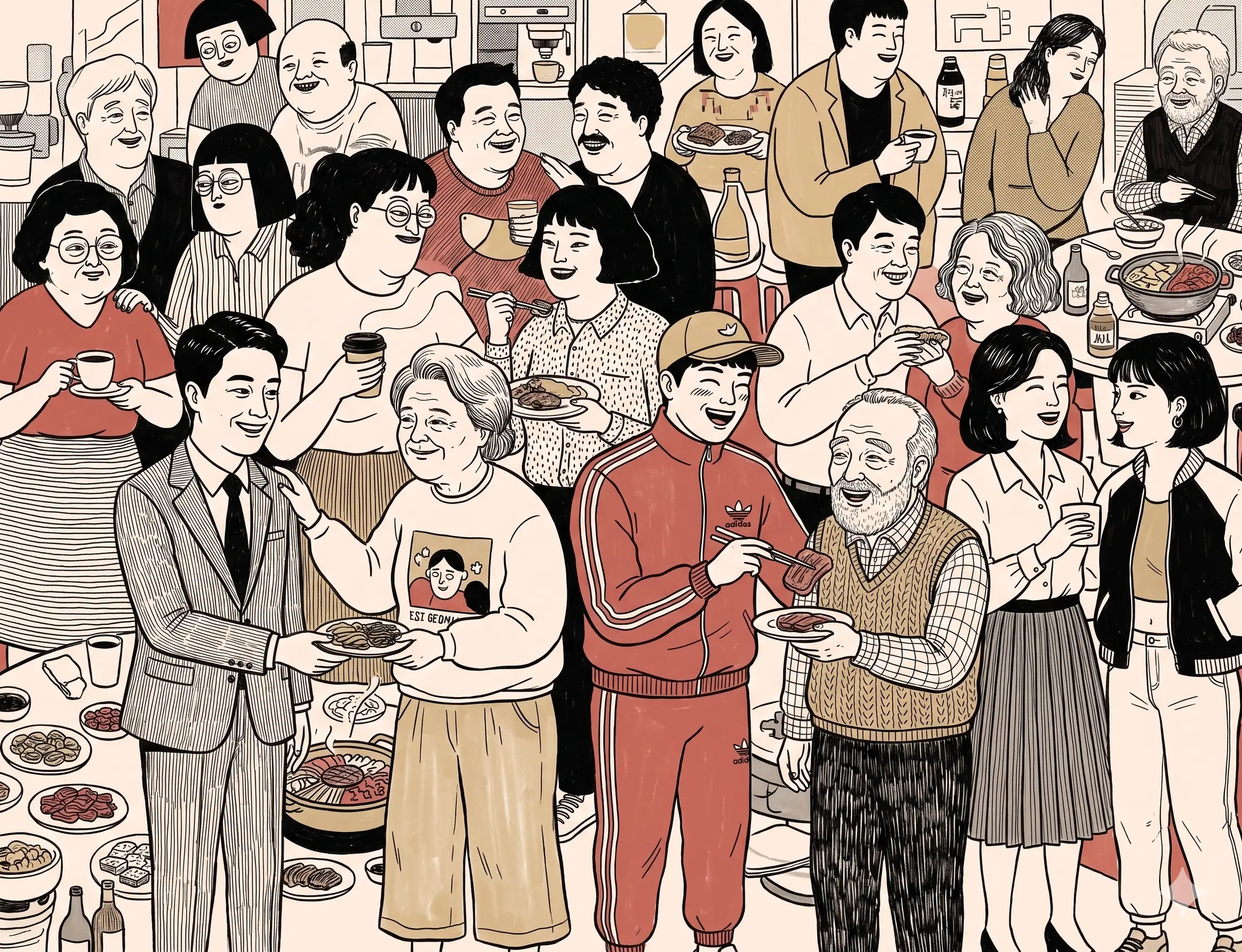
In Korean social theory — both scholarly and popular — nunchi is positioned as a collective capacity rather than an individual talent. A person with bad nunchi is not simply socially awkward; they are failing in a relational obligation. The expectation is that all members of a social group will contribute to the work of collective attunement — that everyone present is reading the room simultaneously, and that this shared perceptual work creates the conditions for harmonious group interaction. Nunchi is, in this sense, a distributed cognitive practice rather than an individual one.
This relational framing distinguishes nunchi from Western concepts of social intelligence or emotional intelligence (EQ), both of which are typically understood as properties of an individual agent. In the Korean framework, the value of nunchi lies not in what it allows the individual to achieve but in what it allows the group to maintain — a state of collective calibration in which individual behaviour is continuously adjusted to the needs and states of others.
Relational obligation: Nunchi is expected of all participants in a social situation, not merely of socially skilled individuals. Its absence (눈치가 없다 — “to not have nunchi”) is a social failure with consequences for group harmony, not merely a personal limitation.
Precision standard: The quality of nunchi is measured by accuracy, not by warmth or social fluency. A person with good nunchi reads the situation correctly; a person with bad nunchi misreads it. The evaluation is perceptual, not interpersonal.
Kibun, nunchi, and the architecture of Korean social space
Nunchi does not operate independently. Its most important context is kibun (기분, 氣分) — the ambient mood or atmosphere of a social situation. If nunchi is the perceptual capacity, kibun is what is being perceived. In Korean social practice, kibun is treated as a real and modifiable condition of a social environment, not merely as a metaphor for mood. Good kibun in a meeting, a dinner, or a professional encounter is something that participants actively work to produce and maintain — and bad kibun is something that can be damaged by an action that lacks nunchi.
The interdependence of nunchi and kibun creates what might be called the architecture of Korean social space: an implicit agreement among participants that the affective state of the environment is a shared resource, that all participants bear responsibility for maintaining it, and that the perceptual precision needed to do so (nunchi) is a cultivated competency, not an instinct. This architecture is not unique to Korean culture, but the degree of explicit social value placed on it — the fact that nunchi is named, taught, discussed, and used as an evaluative category — gives it unusual structural weight in Korean social practice.
In Korean social space, attention is not passive reception. It is the active, distributed work of maintaining a shared environment. Nunchi is the competency this work requires.
Nunchi and European social intelligence — where the comparison holds and where it breaks
The European concept most instructively compared to nunchi is Bourdieu’s habitus — the system of durable dispositions acquired through social experience that governs perception, thought, and action without necessarily becoming conscious. Habitus is the mechanism by which social agents read and respond to their environment in ways that appear intuitive but are structurally conditioned. It operates below the level of explicit social rule-following, shaping behaviour through internalised schemas rather than conscious deliberation.
Nunchi shares the perceptual structure of habitus: both are about reading social situations through dispositions acquired through experience rather than explicit learning. But the comparison breaks at a crucial point. Habitus, in Bourdieu’s framework, is not a virtue. It is a structural phenomenon — the mechanism by which class position is reproduced through bodily and perceptual practice. Its accuracy is not celebrated; it is analysed. Nunchi, by contrast, is explicitly valued. It is taught to children, praised in adults, and cited as a social obligation. It is a normative category, not merely a descriptive one.
Explicitly named, taught, and evaluated. Social failure is identified by the term “눈치가 없다” and taken seriously as a relational lapse.
The unit of analysis is the group, not the individual. Good nunchi serves collective harmony; bad nunchi damages shared social space.
Perceptual accuracy is the value. The standard is correctness — whether you read the situation right — not warmth, empathy, or emotional fluency.
Nunchi operates within a system of relational obligations (kibun maintenance, hierarchical awareness, social face). It is embedded in a specific social architecture.
Habitus (Bourdieu) is a sociological category, not a virtue. It describes how social position shapes perception without endorsing or prescribing any particular perceptual practice.
The unit of analysis is the individual agent, whose dispositions reflect their class position. Social attunement serves individual reproduction of social capital, not collective harmony as such.
Fingerspitzengefühl (German — literally “fingertip feeling”) denotes situational sensitivity in professional and leadership contexts, but it is an individual quality, not a relational obligation.
Neither concept carries the explicit normative weight of nunchi. Both describe social attunement; neither prescribes it as a social duty.
Nunchi in design, fashion, and creative practice
The relevance of nunchi to design and creative practice is not metaphorical. It operates as a concrete structural condition in Korean creative industry contexts — in studio culture, in client relationships, in the dynamics of design review. Understanding it as a structural condition rather than a cultural flavour changes how European designers approach collaboration with Korean studios or brands.
In Korean product design and fashion contexts, nunchi governs the communication of criticism. Direct negative feedback — particularly in hierarchical relationships — is often considered a nunchi failure. The criticism lands, but its delivery damages the kibun of the exchange. The conventional Korean approach is to communicate reservation through registered absence: the silence, the hesitation, the partial approval. A designer with good nunchi reads these signals as clearly as a European designer reads a direct verbal critique. The information is transmitted; the social architecture is preserved.
For European designers and creatives who work with Korean counterparts, this is one of the most frequently cited sources of miscommunication. European design culture — particularly in Germany and the Netherlands — tends to value direct verbal critique as a sign of professional seriousness. The absence of direct negative feedback is often read as approval. In Korean creative contexts, the same absence may carry precise critical information that simply requires nunchi to decode. Neither system is more honest. They transmit information through different channels.
Nunchi is not without its critics within Korean society. Contemporary Korean social commentary — particularly among younger generations — has increasingly identified nunchi as a mechanism for suppressing individual expression under the guise of social harmony. The obligation to read and respond to the room can function as a form of social pressure to conform: to not say what you think, to not act on your own judgement, to subordinate individual perspective to the perceived preferences of the group. In this reading, nunchi is not a perceptual virtue but a conformity mechanism dressed as social intelligence.
Feminist analysis within Korea has noted that the burden of nunchi tends to fall disproportionately on women, junior colleagues, and others in structurally subordinate positions — on those who have the most to lose from damaging the kibun of a superior. In professional contexts, nunchi can reproduce hierarchy rather than merely navigate it. The person with the least institutional power is most obligated to accurately read the affective states of those above them, while those at the top of a hierarchy may be relatively exempt from the same perceptual obligation. This asymmetry is not inherent to nunchi as a concept, but it is visible in its practice.
Fifteen years of working between Korean and European creative environments has given me an unusually clear vantage point on the practical consequences of the nunchi gap. The most consistent pattern I have observed is that European designers and project managers entering Korean professional contexts for the first time tend to misread confirmation as agreement. When a Korean counterpart reads the room and decides that maintaining the kibun of the meeting is more important than stating a reservation directly, a European listener often records the interaction as “no problem raised.” The project then proceeds on the basis of a misreading, and the actual objection surfaces later — typically at a point when changing course is more costly.
The inverse problem is equally real. Korean designers working in European studios often find the directness of German or Dutch critique confrontational in ways that feel disproportionate to the substance of the criticism. The absence of nunchi management in a European design review — the willingness to state a negative assessment directly, without attending to its relational consequences — reads not as professional rigour but as social aggression. Both parties are operating in good faith within their own social logic; neither system has an obvious superiority for the purpose of arriving at good design outcomes.
What I have found useful in practice is to make the mechanism explicit — to name nunchi in cross-cultural working contexts and explain its functional role in Korean professional communication. This does not eliminate the gap, but it shifts the interpretive frame from “personality difference” to “structural difference,” which is both more accurate and more productive for the working relationship.
Frequently Asked Questions
What is nunchi in Korean culture?
Nunchi (눈치) is the Korean social capacity for reading the unspoken affective and relational state of a social situation and adjusting one’s behaviour in response. It is valued as a collective competency — expected of all social participants — rather than an individual talent. Its name is derived from the words for eye (눈) and measurement (치), reflecting its perceptual basis: reading what can be seen rather than what is stated.
How does nunchi differ from European social intelligence?
European concepts of social or emotional intelligence tend to be individual properties — attributes of a particular person that improve their ability to navigate social situations. Nunchi, by contrast, is a relational obligation: a capacity that all participants in a social environment are expected to exercise simultaneously, in service of the group’s collective affective state. The closest European parallel is Bourdieu’s habitus, which also describes socially conditioned perceptual dispositions — but habitus is an analytical category, not a normative one. Nunchi is explicitly taught, evaluated, and used as a social standard.
Is nunchi a form of emotional labour in Korean creative industries?
In structural terms, yes — though the term emotional labour, with its origin in labour sociology, does not map precisely. Korean feminist and social critics have noted that the obligation to exercise nunchi falls disproportionately on those in subordinate social positions, who bear a greater burden of monitoring and maintaining the affective states of superiors. In creative industry contexts, this means junior designers and assistants are expected to read and respond to the unspoken states of senior colleagues with a precision that is not symmetrically demanded of those in higher positions. Whether this constitutes emotional labour in the technical sense depends on the specific professional context.
What does nunchi reveal about collective identity in Korean design culture?
Nunchi reflects a fundamental assumption in Korean social organisation: that the affective state of a group is a shared resource that all members are responsible for maintaining. This assumption has direct consequences for Korean design culture — in how criticism is delivered, how consensus is built, and how hierarchy is navigated in creative contexts. It helps explain why Korean design processes tend to emphasise the social quality of decision-making, not merely the analytical quality of the decisions made. A design outcome is not fully good if the process of arriving at it damaged the relational environment of the team.
Can nunchi be learned by non-Koreans working in Korean professional contexts?
The perceptual skills that nunchi depends on — reading body language, attending to silence and hesitation, sensing group energy — are not culturally exclusive capacities. What is more difficult to acquire from outside the cultural context is the specific vocabulary of Korean social signals: the conventions that determine which silences carry which meanings, which forms of partial confirmation indicate reservation rather than agreement. Familiarity with the structural role of nunchi in Korean professional culture is a useful starting point; the specific signal vocabulary is acquired through extended exposure and, ideally, through direct feedback from Korean colleagues who trust the working relationship enough to name the gap.
Is nunchi specific to Korean culture, or does it have equivalents elsewhere in East Asia?
Concepts structurally similar to nunchi exist in Japanese culture (kuuki wo yomu — reading the air) and Chinese professional contexts, all rooted in Confucian social philosophy’s emphasis on relational harmony and collective calibration. What is distinctive about the Korean framing is the degree to which nunchi is explicitly named, debated, and treated as a social standard — including in contemporary contexts where it is both celebrated and critiqued. The explicit normativity of the Korean concept gives it a different social weight than its functional equivalents in adjacent cultures.
References
- Academy of Korean Studies (한국학중앙연구원 — AKS). aks.ac.kr
- Korea JoongAng Daily — Cultural Analysis. koreajoongangdaily.joins.com
- Bourdieu, Pierre. The Logic of Practice. Trans. Richard Nice. Stanford University Press, 1990. (Original: Le sens pratique, 1980.)
- Choi, Sang-Chin. “The Nature of Korean People’s Social Behaviour.” Korean Social Science Journal, 1994.
- Kim, Uichol, and Choi, Sang-Chin. “Individualism, Collectivism, and Child Development.” In Cross-Cultural Roots of Minority Child Development, eds. P.M. Greenfield and R.R. Cocking. Lawrence Erlbaum, 1994.
- Chang, Kyung-Sup. “Compressed Modernity and Its Discontents.” Sociology, Vol. 33, No. 1, 1999.




Leave a Reply