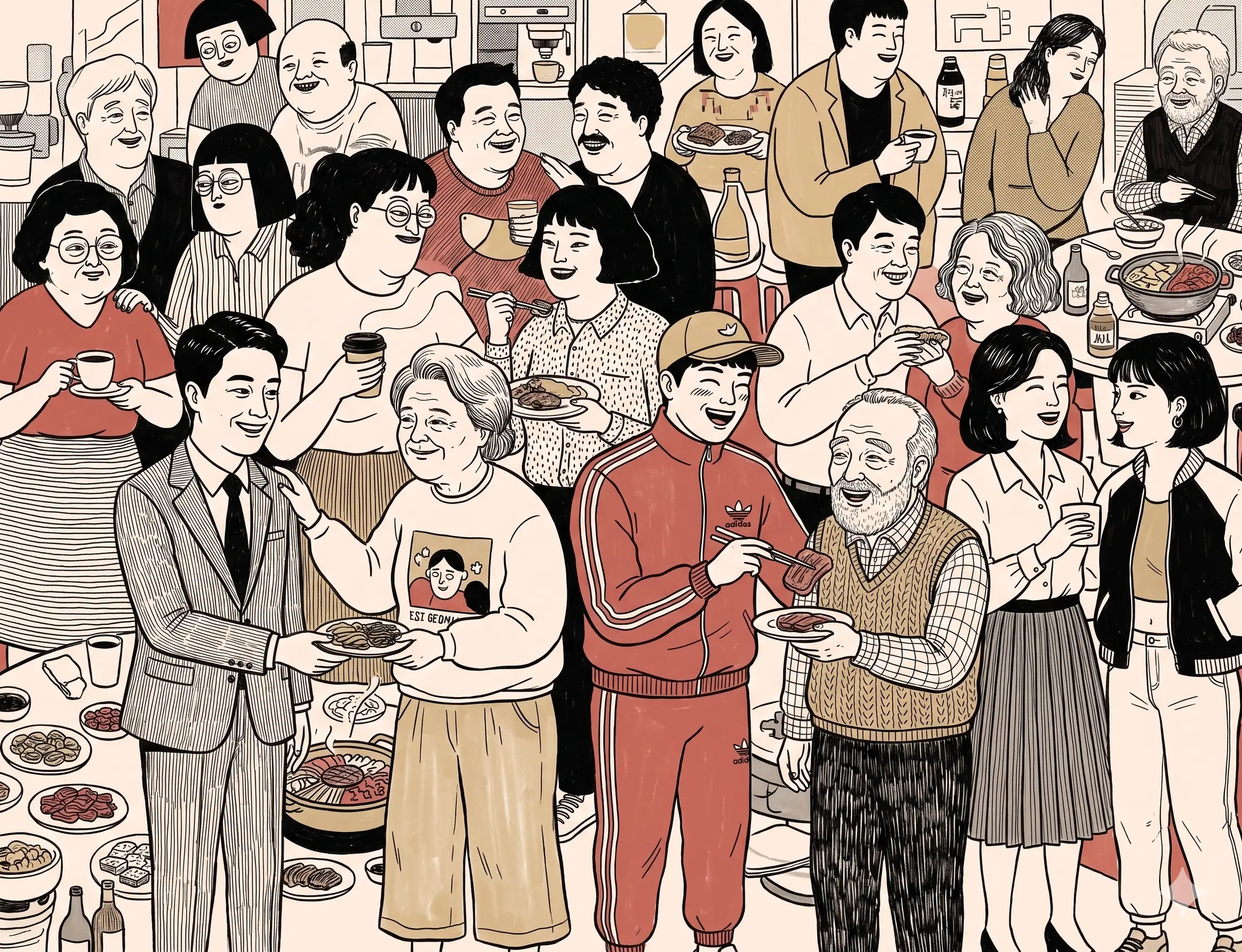
Jeong does not translate as love, affection, or attachment — though all three are sometimes used as approximations. The reason these translations fall short is not linguistic but structural: jeong is not a feeling that one person has toward another. It is a deposit that accumulates between people through time, shared experience, and mutual presence — a property of the relational space between individuals rather than of either individual alone.
Jeong (정, 情) is the Korean concept of relational attachment formed gradually through shared time and co-presence, resulting in a bond that persists even in the absence of active affection and that resists voluntary termination. In Korean social and interpersonal life, it functions as the affective substance of long-term relationships — the accumulated residue of experience that makes a place feel like home, a colleague feel like family, or a difficult relationship feel impossible to simply leave.
The European parallel most often cited is Bowlby’s attachment theory, which identifies similar dependency bonds between caregiver and child. The comparison breaks at two points: attachment theory describes bonds formed by developmental necessity in early childhood, while jeong develops across all relationship types throughout life; and attachment theory is an individual psychological phenomenon, while jeong is understood as residing in the relational space between people rather than in either party’s psychology.
The English word “feeling” imports a particular ontological framework — emotions are states of individual subjects, located in internal experience, produced by perception of external objects. You feel love for someone; they are the object of your love. In this framework, love is yours — a state of your nervous system, your psychology, your experience. It can be extinguished if the perception of the object changes, if the object disappears, or if you choose to direct attention elsewhere.
Jeong does not fit this model. It is not a state you have toward another person. It is something that has formed between you and another person — or between you and a place, an object, a time in your life. It accumulates without being cultivated, attaches without being willed, and persists without being sustained by ongoing positive feeling. You can have jeong for someone you find difficult. You can have jeong for a neighbourhood you are glad to have left. The presence of jeong does not indicate that the relationship is positive — only that it has depth of accumulated co-presence.
The typology of jeong — misum-jeong, bap-jeong, and the varieties of attachment
Korean has a developed vocabulary for the varieties and conditions of jeong, which is itself evidence of the concept’s analytical importance in Korean emotional culture. The most frequently cited distinctions are between jeong formed in affection and jeong formed in something more ambivalent:
Miuum-jeong
Bap-jeong
Jeong as temporal deposit — how accumulation works
The temporal structure of jeong is its most distinctive feature from a European comparative perspective. In European emotion theory, emotions tend to be understood as responses to present conditions — states triggered by current perception, sustained by ongoing attention, and extinguished when the triggering conditions change. Love in the romantic tradition intensifies with novelty and positive experience; it fades with familiarity, absence, or negative experience. It is, in this model, a functional response to relational conditions.
Jeong operates on a different temporal logic. It is not a response to present conditions — it is an accumulation from past conditions. The more time and experience shared, the more jeong has formed, regardless of whether the current emotional quality of the relationship is positive. This means that jeong increases with relationship duration in a way that is independent of relationship quality. A long difficult marriage contains more jeong than a short happy one. A childhood neighbourhood contains jeong in proportion to how many formative years were spent there, not in proportion to how pleasant those years were.
Jeong is not a feeling you have. It is an accumulation that has formed — in the space between you and another person, or between you and a place, or between you and a time in your life that cannot be unformed by changing how you feel about it.
The practical consequence is that Korean social relationships resist the clean termination that European emotion models would suggest is possible and even healthy. If love fades, European frameworks suggest, one moves on. If jeong has accumulated, Korean social culture suggests that moving on is structurally more complicated — not morally prohibited, but emotionally costly in a way that simple preference change cannot resolve. The Korean concept of “jeong when cutting ties” (정 떼기, jeong ttegi) describes the specific emotional labour of dissolving a relationship that has accumulated significant jeong, which is understood as distinct from simply no longer feeling warmth toward someone.

Jeong and European attachment theory — convergence and structural difference
Bowlby’s attachment theory, developed from the 1950s and elaborated by Ainsworth’s Strange Situation studies, identifies the formation of persistent emotional bonds — particularly between infant and primary caregiver — as a foundational developmental mechanism. Securely attached individuals develop an internal working model of relationships as reliable and available; insecurely attached individuals develop various compensatory strategies. The bonds themselves are understood as psychologically real, motivationally powerful, and resistant to voluntary dissolution.
These features have obvious structural parallels to jeong: both describe bonds that form through co-presence and shared experience, persist independently of ongoing positive feeling, and resist voluntary termination. But the comparison reveals important structural differences. Attachment theory is a developmental psychology model — it describes bonds formed primarily in early childhood that shape subsequent relational patterns. Jeong is not developmental; it forms throughout life in all kinds of relationships, including the workplace, the neighbourhood, and with inanimate environments. Attachment theory locates bonds in the psychology of individual subjects. Jeong is understood to reside in the relational space between parties — it is not possessed by either individual but is shared between them.
Forms across all relationship types throughout life — not limited to primary caregiving bonds. Jeong can accumulate with colleagues, neighbours, places, and objects as readily as with family members.
Resides in the relational space between persons, not in either person’s individual psychology. It is a shared property of the relationship, not a state of either party.
Accumulates through shared time and co-presence independent of emotional quality. Difficult relationships accumulate jeong; pleasant relationships accumulate jeong. The rate of accumulation correlates with duration and intensity of contact, not with positive feeling.
Can form without mutual recognition. One person can have more jeong than the other in an asymmetric relationship; the asymmetry itself is a recognised social condition.
Primarily describes bonds formed in early childhood between infant and primary caregiver. Adult attachment patterns are understood as derivatives of these early developmental bonds rather than independently formed.
Located in individual psychology — internal working models, secure/insecure attachment patterns. The bond is a property of the individual’s relational system, not a property of the relational space itself.
Positive and secure bonds are associated with positive relational experience. Insecure attachment is associated with inconsistent or neglectful caregiving. Emotional quality of the relationship affects attachment quality.
Implies mutual recognition and response — attachment behaviours are directed at an attachment figure who responds. Asymmetric attachment (where one party does not reciprocate) is understood as a pathological condition.
Jeong in consumer culture and design — why Korean brands value long-term loyalty differently
The jeong concept has direct implications for how Korean brands approach customer relationships. European consumer culture tends to model brand loyalty as a rational preference calculation — the consumer chooses the brand that offers the best value, and loyalty continues as long as value is delivered. This is an exchange model: the consumer gives money, the brand gives value, the relationship continues as long as the exchange is favourable.
Korean brand relationships, particularly in categories like food, retail, and personal care, are modelled on jeong accumulation rather than exchange value. The Korean term dan-gol (단골, regular customer) describes a relationship between a customer and a specific vendor or shop that is understood as accumulating jeong over time. The dan-gol relationship is not primarily about price or product quality — it is about the accumulated relational deposit of repeated visits, recognised familiarity, and the specific form of trust that jeong generates. Korean consumer brands that have successfully cultivated dan-gol relationships can sustain loyalty through product quality lapses and price changes that would dissolve exchange-model brand relationships.
The temporal persistence of jeong — its resistance to voluntary dissolution and its accumulation independent of ongoing positive feeling — has been analysed by Korean feminist scholars as a mechanism that traps people in relationships they might otherwise leave. The emotional cost of jeong dissolution (jeong ttegi) is real and socially recognised; the cultural expectation is that accumulated jeong creates an obligation to preserve the relationship beyond the point at which individual welfare would recommend leaving it. For women in difficult marriages, for employees in abusive workplaces, for young people in families where they are not accepted, the language of jeong can function as social pressure to maintain relationships that harm them.
Contemporary Korean cultural analysis, particularly from writers in the feminist and queer communities, has engaged critically with the extent to which jeong discourse naturalises relational obligation. The argument is not that jeong is pathological but that the cultural valorisation of accumulated relational bonds, without an equally robust cultural vocabulary for healthy termination of harmful relationships, distributes the cost of jeong maintenance unequally — typically onto those with less social power to exit.
Frequently Asked Questions
What is jeong in Korean culture?
Jeong (정, 情) is the Korean concept of a relational bond that accumulates through shared time and co-presence between people, places, or things. Unlike European emotion concepts that locate feelings in individual subjects, jeong is understood to reside in the relational space between parties — it is shared rather than possessed. It persists independently of ongoing positive feeling, increases with relationship duration, and resists voluntary dissolution in ways that European attachment and affection concepts do not fully capture.
Can jeong develop in negative relationships?
Yes — this is one of jeong’s most structurally significant features. Miuum-jeong (미움정) is the jeong that forms through repeated negative contact — the bond that develops with a difficult colleague, a challenging family member, or a person with whom one is in persistent conflict. The familiarity, the habituated presence, and the shared history of difficulty all accumulate into a form of jeong that makes separation unexpectedly costly even when the relationship has never been warm. European emotion theory would predict that negative relationships weaken emotional bonds; the jeong model predicts that any sufficient sustained contact, positive or negative, accumulates relational deposit.
How does jeong differ from European concepts of love or attachment?
The primary structural difference is location and causation. European emotion concepts — love, affection, attachment — are states of individual subjects caused by perception of valued others. They are properties of a person’s internal psychology. Jeong is a property of the relational space between persons — not possessed by either party but shared between them. Additionally, jeong’s causation is purely temporal: it accumulates through co-presence and shared experience regardless of emotional quality, whereas love and affection in European models intensify with positive experience and fade with negative experience or absence.
What is bap-jeong and why is shared eating significant in Korean culture?
Bap-jeong (밥정) is the jeong specifically formed through repeated shared meals. In Korean cultural practice, eating together is a bond-forming act in its own right — not a vehicle for conversation but a relational practice that produces a specific type of intimacy. The Korean social emphasis on team meals, family dinner rituals, and food-centred hospitality reflects this understanding: the meal is not merely a social context but the primary site of jeong accumulation in many Korean relationships. “밥 한 번 먹자” (Let’s have a meal sometime) is not casual — it is an invitation to begin the accumulation of bap-jeong.
What is jeong ttegi (정 떼기) and why is it emotionally significant?
Jeong ttegi (정 떼기) is the deliberate act of dissolving accumulated jeong — cutting emotional ties with a person, place, or situation to which significant jeong has accumulated. Because jeong persists independently of ongoing positive feeling, its dissolution requires active effort rather than simply allowing affection to fade. Korean social and therapeutic discourse recognises jeong ttegi as a specific emotional labour with its own difficulty, distinct from merely losing interest in someone. The cultural recognition of this difficulty reflects the jeong framework’s premise: you cannot simply decide to stop having jeong — you must undertake the work of untangling accumulated relational deposit.
References
- Academy of Korean Studies (한국학중앙연구원). aks.ac.kr
- Choi, Sang-Chin. “The Nature of Korean People’s Social Behaviour: The Analysis of Inhwa, Kibun, Nunchi, and Jeong.” Korean Social Science Journal 20, 1994.
- Kim, Uichol, et al. “The concept of jeong: Qualitative and quantitative approaches.” In Progress in Asian Social Psychology Vol. 4, 2000.
- Bowlby, John. Attachment and Loss, Vol. 1: Attachment. Basic Books, 1969.
- Ainsworth, Mary D.S. Patterns of Attachment. Lawrence Erlbaum, 1978.
- Korea JoongAng Daily — jeong in contemporary Korean culture. koreajoongangdaily.joins.com



Leave a Reply