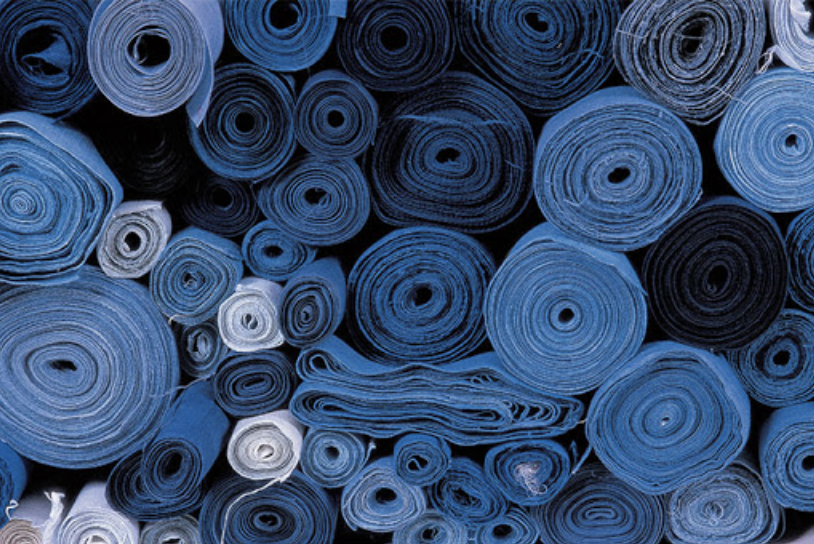

When you pull indigo-dyed cloth from the vat, it looks wrong — green, slightly sulphurous, no blue visible. Then oxygen acts on it, and within seconds the colour arrives: green to teal to blue, deepening as you watch. The colour is not in the vat. It is produced by the cloth meeting air.
That transformation — fermentation-reduced indigo becoming visible blue through oxidation — is the central chemistry of jjok dyeing. It is also why the craft has the character it does: no single dip produces the final result. The depth of colour in a piece of jjok-dyed cloth is the record of how many times it entered and left the vat, how long it oxidised between dips, and what the vat concentration was during each cycle. The object carries its own process history in its surface. This is not metaphorical — it is a direct consequence of how indigotin chemistry works.
The Chemistry Behind the Colour
Synthetic equivalence: Synthetic indigo — chemically identical to natural indigotin, available since 1897 — now dominates commercial production globally. The dye molecule is the same. What natural fermentation vat dyeing produces that synthetic cannot is the variation pattern across the surface: slight differences in dip depth, fibre absorption, and oxidation timing produce colour variation that registers as surface texture in finished cloth. Synthetic indigo produces uniform coverage; natural vat dyeing does not. Whether that distinction justifies the cost differential depends on what the object is for.
Fade behaviour: Natural indigo oxidation continues slowly throughout the garment’s life, producing a patina that differs from the uniform bleaching of synthetic-dyed cloth. The aged quality of jjok-dyed cloth is the same chemistry — ongoing oxidation — that produced the original colour, continuing at a slower rate. This ongoing material process is shared with other natural Korean materials — hanji, for example, continues to develop character with handling and light exposure in a way that processed paper does not. (On hanji’s material behaviour over time →)
The Vat as an Active System
Indigo cannot be simplified into a dye recipe because the fermentation vat is not a stable chemical solution — it is a living microbial system that must be maintained daily. The vat’s function depends on the reduction state of the indigotin at any given moment, which is determined by the balance between microbial activity (which reduces the indigo) and oxidation from air contact (which reverses it). An experienced dyer reads the vat by smell, surface colour, and the foam pattern on the surface — a working vat in good condition produces a specific bronze-purple foam (called the “flower” of the vat) that indicates correct reduction state.
The traditional Korean fermentation vat process begins weeks before any cloth enters it. Jjok plant material is harvested at peak indigotin concentration — timing varies by growing conditions — then macerated and combined with lime (historically from oyster shells in coastal Jeolla Province, contributing to regional process specificity), water, and fermentation agents. pH must be maintained in the alkaline range for reduction to proceed; too acidic and the vat fails. Temperature affects the rate of microbial activity. A vat that is not monitored daily deteriorates — and a dead vat requires reconstruction from the beginning, not adjustment.


Naju and the Geography of the Craft
When Korean sources discuss jjok dyeing, Naju (나주) in South Jeolla Province appears consistently and not arbitrarily. The region’s climate and river basin conditions suit indigo cultivation, and the area maintained the full infrastructure — cultivation, processing, textile production — that concentrated expertise across generations. The most formally recognised living practitioner, Jung Kwan Chae, holds National Intangible Cultural Heritage No. 115 in natural dyeing and is based in Naju. His studio (정관채 jeonggwanchae) is the most directly documented example of the tradition in continuous operation.
The Naju Natural Dyeing Culture Center (나주천연염색문화관) functions as both museum and active cultural space. It presents the dyeing tradition through the full agricultural and technical process rather than treating the final dyed cloth as the starting point for explanation. For designers and researchers, the centre is one of the more substantive places to encounter the craft in context — which means understanding the cultivation calendar, the vat maintenance cycle, and the dipping sequence as an integrated system rather than a final colouring step. When jjok-dyed cloth does appear in Seoul’s material markets, it arrives as a finished material sourced from Naju and equivalent production centres — understanding where it comes from makes its price and material behaviour considerably more legible. (On where Seoul designers source natural materials →)

The Colour Range — Not Just Deep Blue
Jjok dyeing is not a single colour — it is a range from very pale blue-grey through medium teal to near-black navy, all achievable from the same vat at different dip counts and concentrations. The pale washes achievable in three or four dips are not failures or incomplete versions of the dark navy — they are a different, earlier point in the colour range, with their own aesthetic character. The colour progression does not accumulate linearly: the rate of deepening slows as saturation increases, meaning the difference between 10 and 20 dips is less than the difference between 2 and 12.
For designers working with jjok, this range is the material’s full vocabulary rather than a limitation to work around. The palest dips produce a washed quality — flat, quiet, with the surface texture of the base textile dominant. Middle-depth dips produce the blue-teal range where natural vat variation is most visible across the cloth surface. Deep navy dips produce near-uniform colour but retain the characteristic oxidation behaviour over time. Each part of the range has different applications. This relationship between process depth and aesthetic character — where more investment in process produces a richer, more complex result rather than simply a darker colour — parallels the layering logic of najeon chilgi, where additional lacquer coats add optical depth rather than simply covering what is beneath. (On depth as a design property in najeon chilgi →)
The depth of colour in jjok-dyed cloth is literally the record of the process that produced it. The object carries its own history in its surface — not metaphorically. This is a direct consequence of indigotin chemistry.
The Sustainability Frame — and Where It Is Incomplete
Natural dyeing is frequently framed primarily as a sustainability choice. That framing is not inaccurate but it tends to displace the more interesting analytical question, which is what the aesthetic result specifically is and why it cannot be fully replicated by other means. The resource implications of fermentation vat dyeing — water use, agricultural inputs, the ongoing maintenance burden of a living vat — are real and not always acknowledged in promotional framing. The environmental case for natural dyeing is more complicated than it is typically presented.
What is not in question is the aesthetic specificity of the result. Jjok-dyed cloth with natural indigotin has a surface quality that denim finished with synthetic indigo does not: the variation, the fade behaviour, the way the colour shifts under different light angles. Whether that specificity justifies the cost differential between natural and synthetic indigo is a question of values and use context, not of chemistry. The craft makes most sense when the material specificity — the variation, the depth, the process-visible-in-the-surface — is the intended quality of the object, not incidental to it.
The aspect of jjok dyeing that I find most directly relevant to contemporary material design practice is the relationship between process control and outcome variation. In industrial production, variation is generally managed out — the goal is uniform, reproducible results. Natural vat dyeing has a different logic: the vat is a variable system, and the variation it produces across a length of cloth is part of the material’s intended character rather than a quality defect. Designing with this material means designing with variation as an expected property, not as a problem to solve.
In product development terms, this distinction matters at the specification stage. If you are working with jjok-dyed cloth and specifying it for production, the tolerance for colour variation needs to be built into the specification rather than treated as non-conformance. This is a different design workflow than working with synthetic materials, and it requires the designer to have a clear position on whether the variation is part of the product’s value proposition or a constraint to be minimised. Both positions are defensible — but they lead to different design decisions and different production approaches.
References
- Naju Natural Dyeing Culture Center (나주천연염색문화관) — Full process documentation from cultivation through dyeing; exhibition and workshop records.
- Cultural Heritage Administration — National Intangible Cultural Heritage No. 115: Jung Kwan Chae (정관채) natural dyeing designation.
- Korea Craft & Design Foundation (KCDF) — Contemporary natural dyeing practitioners, contemporary design applications.
- National Folk Museum of Korea — Historical context of Korean natural dyeing in court and domestic textile culture.
- Balfour-Paul, Jenny. Indigo: Egyptian Mummies to Blue Jeans. London: British Museum Press, 1998. — Cross-cultural comparative context for indigo chemistry and fermentation vat processes.



Leave a Reply