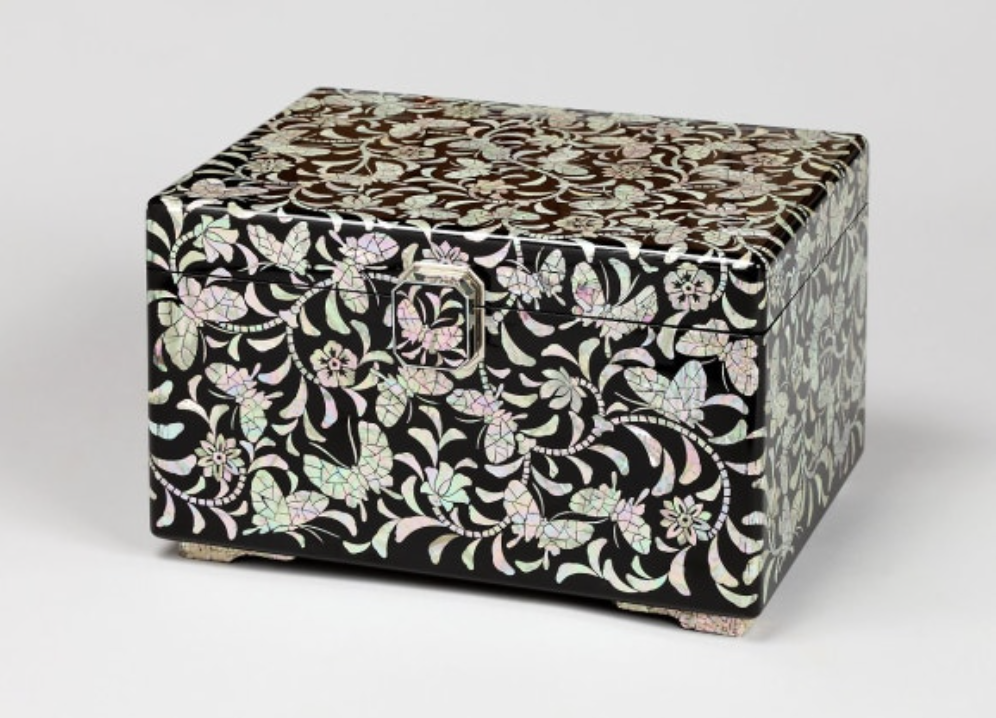

There is a moment when looking at a najeon chilgi piece when the surface does something unexpected: it appears to contain interior space that a flat object cannot have. That effect is not accidental. It is the structural purpose of the entire technique.
Najeon chilgi (나전칠기) is sometimes shortened to jagae (자개) in everyday Korean usage. The full term is technically precise: najeon (나전) means mother-of-pearl inlay; chilgi (칠기) means lacquerware — objects coated in the resin of the lacquer tree (Toxicodendron vernicifluum). The combination of these two materials, layered over a wooden substrate, produces objects that European design audiences tend to encounter in museum cases and underestimate. The underestimation is usually because the material logic — why each component is doing what it is doing — is not visible on the surface of the object. It requires understanding the structure underneath.
Three Materials, One Optical System
Preparation: The wood is sized with a hemp cloth layer before lacquer application, reinforcing the surface and providing a mechanical key for the first lacquer coats. This cloth layer is invisible in the finished object but critical to the lacquer’s long-term adhesion.
Optical function: Multiple lacquer layers above the mother-of-pearl inlay act as a lens. The refractive index of cured urushi differs from air, and the light passing through the layered structure shifts angle depending on depth. The apparent interior space in a good najeon chilgi surface comes from this lens effect — the shell is not at the surface but below it, visible through a depth of transparent lacquer. This layering logic — materials sequenced so that each does something the others cannot — has a direct parallel in Korean textile thinking, where fibre structure is also chosen for what it does across layers rather than on its surface alone. (On hanji’s layered fibre structure →)

Cutting and inlay process: Shell is split into thin sheets, then cut into shapes using small scissors and knives. Two primary cutting techniques: juseum (주름질) produces fine, linear marquetry-style cuts; ipsa (입사) involves sawing the shell into strips first. The pieces are pressed into a still-tacky lacquer layer in the designed pattern, then smoothed flush. Additional lacquer coats follow, encasing the inlay. Final polishing brings the shell’s iridescence back to the surface through the lacquer lens.
Scale of work: Surviving Goryeo-era examples in the National Museum of Korea include inlay work where individual shell pieces measure only 2–3 millimetres across — achieved without magnification tools. The technical precision is not incidental to the aesthetic result; it is the aesthetic result.

Goryeo to Joseon: A Shift in Function, Not Technique
The craft’s documented history runs from the Goryeo dynasty (918–1392) into the Joseon period (1392–1910). The technical vocabulary — wood, lacquer, shell — is continuous. What changes is the objects the technique is applied to and the social context of their use.
Goryeo-era najeon chilgi was associated primarily with Buddhist objects and royal commissions: sutra boxes, ritual vessels, furniture for court and temple. The inlay patterns of this period tend toward dense, fine-line forms — chrysanthemums, paulownia, vines — at a scale that indicates production for display and ceremony rather than daily handling. Some of the finest surviving examples, held at the National Museum of Korea, show work that is difficult to assess as labour without first acknowledging the time it required.

The Joseon period shifted the function toward the secular domestic life of the yangban household. Objects — document boxes, stationery sets, cosmetic cases, furniture — were designed for daily use. Motifs shifted accordingly: less sacred symbolism, more nature and flora associated with Neo-Confucian literati values. This shift toward the everyday is one reason Joseon najeon chilgi feels less remote than Goryeo examples — it was made to be handled, not only to be observed. The same Joseon domestic material culture that produced najeon chilgi cosmetic cases also produced jjok-dyed cloth for everyday garments — two crafts sharing a period, a social context, and a common logic of material specificity as cultural practice. (On jjok dyeing in Joseon material culture →)
The Colonial Interruption and What It Means for the Craft Now
The Japanese colonial period (1910–1945) significantly disrupted many Korean craft traditions — najeon chilgi among them. Transmission chains were broken, production was redirected toward aesthetics aligned with Japanese commercial preferences, and the conditions for training successors were removed from many master practitioners. The Korean War further fragmented what remained.
The Korean government’s system of designating Important Intangible Cultural Heritage (중요무형문화재) and naming individual practitioners as Inganmunhwajae (인간문화재) — Living National Treasures — exists partly in direct response to this history. The designation recognises that certain skills are embodied knowledge: they do not survive in documentation alone. They require continuous transfer from a practitioner who has spent years developing bodily competence to a successor willing to do the same. Najeon jangin (나전장) — the nacreous inlay artisan designation — is National Intangible Cultural Heritage No. 10.
The optical quality of traditional najeon chilgi comes from the refractive index of cured urushi. It cannot be fully replicated with synthetic lacquer. If you are evaluating a piece, the depth and behaviour of the light through the surface is the most reliable indicator of the material used.
What “Contemporary Najeon Chilgi” Means — and Why the Distinction Matters
There are practitioners working today who maintain the full traditional process — wood preparation, successive natural lacquer coats, hand-cut shell inlay, final polishing — and whose work falls squarely within the historical technical vocabulary of the craft. There are others who have introduced synthetic resins or pre-fabricated shell sheets, which is sometimes described as adaptation and sometimes as a different process sharing a name.
The distinction matters for designers and researchers because the optical properties that define traditional najeon chilgi are specific to natural urushi lacquer. The refractive index and layering behaviour of cured urushi — which creates the apparent depth in the surface — is not fully reproducible with synthetic alternatives. A piece made with synthetic resin may be visually similar at normal viewing distance and substantially different in close examination and in how the surface behaves under changing light conditions. This is not a value judgement about which approach is more appropriate for contemporary production; it is a description of what is different between them. An analogous distinction appears in other Korean craft traditions where material substitution changes the result in ways that are visible only to someone who knows what the original material does — the gat’s horsehair surface is another example where the optical and structural properties of the specific material are not separable from the aesthetic result. (On horsehair’s transparency as a design property →)

From a product development background, the element of najeon chilgi that most directly maps onto contemporary material thinking is the layering logic. The object is not a single material — it is a system of materials where each layer is doing something that the others cannot do alone. The wood provides form. The lacquer provides protection and optical depth. The shell provides colour and iridescence through the lacquer lens. Remove any one component and you have a different object, not a simpler version of the same one. That kind of layered material logic is relatively rare in contemporary industrial production, where materials are more often selected for a single function.
The curing process — requiring specific humidity rather than being inhibited by it — is the element I find most interesting from a materials science perspective. Most finishing processes work against humidity; urushi requires it. That inversion of the usual material logic is directly connected to the durability of historical pieces: a process that works with the environment rather than against it produces results that last differently than one that fights it. Some of the most durable historical objects in Korean museum collections are najeon chilgi pieces that have survived humidity cycling for six or seven centuries. No synthetic finish comes close to that track record.
References
- National Museum of Korea (국립중앙박물관) — Goryeo and Joseon najeon chilgi collection, documented object analysis.
- National Folk Museum of Korea (국립민속박물관) — Joseon domestic objects, craft process documentation, social use context.
- Korea Craft & Design Foundation (KCDF) — Contemporary lacquerware practitioners, craft revival documentation.
- Cultural Heritage Administration — 나전장 (Najeon jangin) National Intangible Cultural Heritage No. 10 designation and transmission records.
- Son Daehyeon / 손대현 — First Korean lacquerware master; documented practice and workshop records via KCDF and NMK archives.


[Check Najeonghilgi products on Amazon->]
[Check Jagae DIY Video on Youtube->]
[Check Jagae DIY sticker on Amazon->]



Leave a Reply