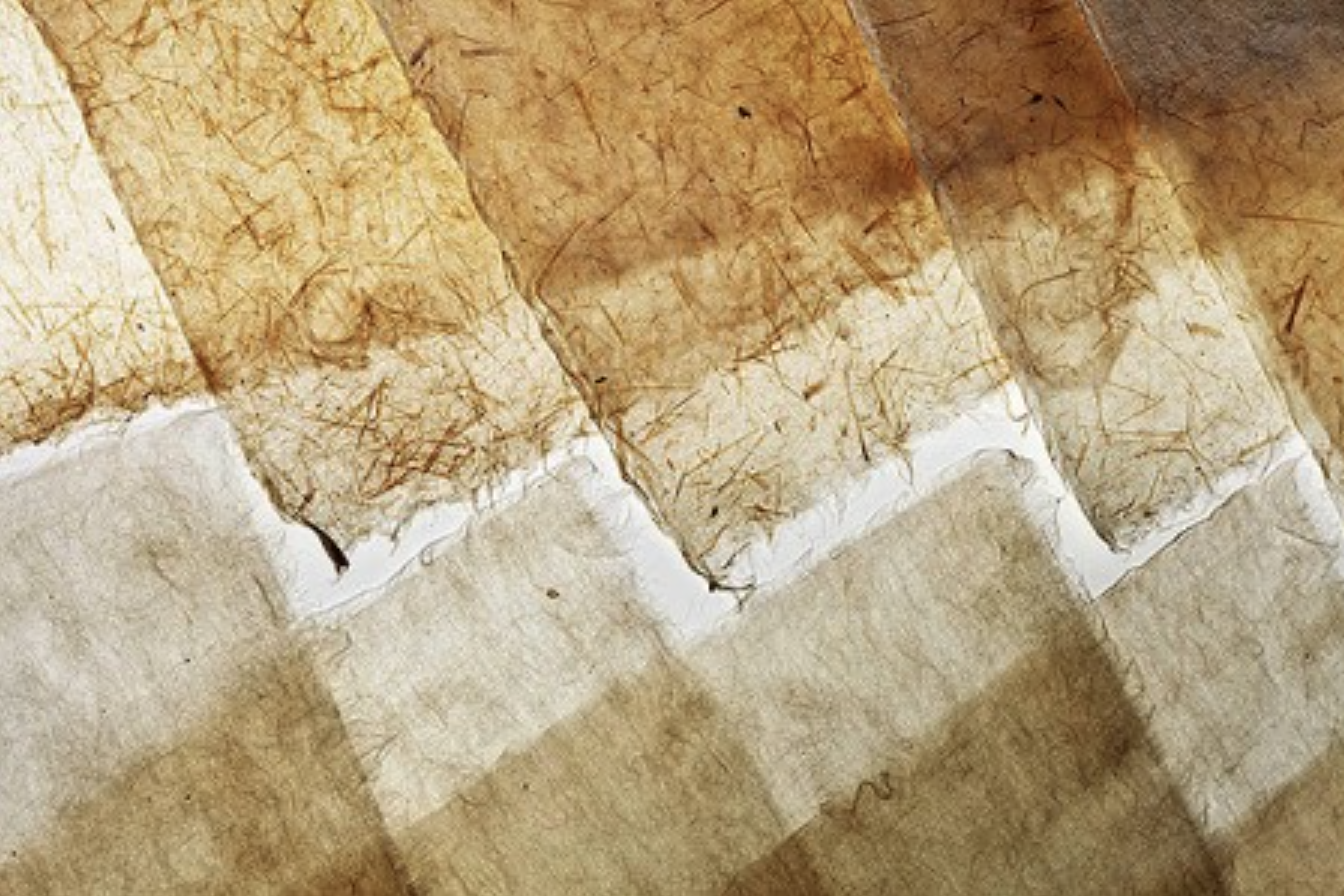
Paper is not a structural material. Hanji behaves differently enough from that baseline that the comparison is more misleading than useful. The more accurate reference point is linen or ramie: a bast fibre material with tensile logic, surface character, and specific constraints that define what it can and cannot do.
Hanji (한지) is traditional Korean paper made from the inner bark of the paper mulberry tree (Broussonetia papyrifera). It is produced through jangpan (장판지) papermaking — a process that differs from Western papermaking in one fundamental way: the fibres are beaten more thoroughly and oriented less uniformly, producing a sheet with strength distributed in multiple directions rather than primarily along the grain.
This non-directional fibre distribution is why historical hanji documents have survived humidity cycles, insect exposure, and repeated physical handling over centuries. The craft’s own description of hanji as 천년 한지 (thousand-year paper) refers to this durability — a measurable material property, not a cultural claim. Treated hanji used in fashion applications typically achieves tensile values closer to thin woven textiles than to conventional paper. It can be folded, stitched, and — depending on treatment — wetted and dried without losing structural integrity.
Material Properties That Matter for Design Applications
Breathability: Non-woven fibre structure allows air movement laterally as well as perpendicularly. Thermal behaviour differs from woven textiles of similar weight. This is a real, measurable property — it is why hanji has been used historically in room partitions, bedding, and garments, not only as a writing surface.
Moisture behaviour: Hanji absorbs moisture readily, which contributes to breathability but also means that untreated hanji changes dimension and loses some structural integrity when wet. Fashion applications requiring water resistance need surface treatment — natural waxes, resins, or bio-based coatings. The treatment changes surface character and must be integrated into the design process, not added as an afterthought.
Dyeability: Accepts natural dyes well, including jjok (indigo), chija (gardenia yellow), and oseberry red. (For a detailed breakdown of how Korean indigo dyeing (jjok) works at a material level — including fermentation, reduction, and colour fixation — read more here.) Good colour depth and low dye loss compared to some synthetic substrates. Compatible with traditional Korean natural dyeing in both technical and cultural terms.


The antibacterial claim requires careful handling. The compounds are real. Whether they survive hanji processing at useful concentrations is a more complex question than product descriptions typically acknowledge.
Mulberry bark does contain flavonoids and hydroxycinnamic acids with demonstrated antimicrobial activity in laboratory conditions. Whether those compounds survive the processing required to produce fashion-ready hanji, and at what concentration, is a question the published evidence does not fully resolve. The claim is not unfounded — but it is often presented with more certainty than the evidence supports. For designers evaluating hanji as a material, the structural and thermal properties are well-characterised and reliable; the antibacterial property should be treated as a probable benefit rather than a guaranteed specification.
| Processing Level | Surface Character | Translucency | Primary Design Application |
|---|---|---|---|
| Minimal (lightly beaten) | Fibrous, matte, visible texture | High — allows light transmission | Lampshades, translucent garment panels, paper screens |
| Standard | Moderate texture, semi-matte | Medium | Structural garment panels, accessories, architectural surfaces |
| Heavily processed | Smooth, printable surface | Low | Print applications, treated bags and shoes (with water-resistance coating) |
| Spun hanji thread + weave | Textile-like, variable by base weave | Depends on base textile | Garment fabrics, upholstery — most practical for wearable applications |


How Seoul Fashion Week Has Used It
Several Seoul Fashion Week presentations over recent seasons have incorporated hanji as a structural or surface element. The approaches divide into two distinct types that reflect different design decisions about what the material is being asked to do.
The first approach exploits hanji’s mouldability when damp: the material can be shaped over a form and holds that shape when dry, allowing three-dimensional construction without internal support structures. This has appeared in collar constructions, shoulder volumes, and garment panels where architectural form was the design priority. The constraint is dimensional stability under subsequent moisture exposure — either surface treatment is required, or the design accepts gradual deformation through wear as part of the object’s character.
The second approach uses hanji spun into thread and woven with cotton, linen, or hemp to produce a hybrid fabric with hanji’s surface texture and dyeability alongside the mechanical properties of the base textile. This is the more practical route for garments that need to function through washing and regular use. The resulting fabric handles more like conventional cloth while retaining hanji’s distinctive visual texture — the matte, slightly irregular surface quality that distinguishes it from standard wovens.


The Design Question the Material Raises
Hanji has attracted serious attention from textile and fashion designers not as a novelty or a sustainability gesture, but as a material with properties that happen to solve specific design problems. The breathability profile is genuinely unusual — lateral air movement through a non-woven structure differs from the porosity of woven textiles in ways that affect thermal performance at low garment weights. The mouldability enables three-dimensional form-making that is not available from conventional textiles without internal support structures. The dyeability connects to a tradition of Korean natural colouring that produces surface qualities distinct from synthetic-base dyeing.
The constraint — moisture instability in untreated form — is real and must be designed with rather than around. The most successful hanji applications in contemporary design are the ones that have worked out this constraint specifically for the application, not the ones that have applied hanji as a surface to a conventional garment structure.
From a product development background, the most consistently underestimated aspect of hanji in design discussions is the fibre orientation question. The non-uniform orientation that gives hanji its multidirectional strength is also what gives it its surface character — that slight irregularity, that refusal to have a clear grain line. When hanji is used as a structural element in three-dimensional construction, this matters: the material does not have a “strong direction” to align with the load path. Designers used to woven textiles, where warp orientation matters enormously, need to recalibrate their approach.
The spun hanji thread and blend approach is the direction I find most interesting for fashion applications. Blending introduces the conventional handling properties that allow hanji to be cut and sewn with standard equipment, while preserving the surface quality that distinguishes it visually. The challenge is specifying the blend ratio — too much base textile and the hanji character disappears; too little and the handling problems of pure hanji return. The proportion needs to be determined for each specific application, not adopted from a standard specification.
References
- Korea Craft & Design Foundation (KCDF / 한국공예·디자인문화진흥원) — Contemporary craft and design applications documentation, hanji textile development records.
- Seoul Museum of Craft Art (서울공예박물관) — Collection and exhibition documentation of hanji applications in contemporary craft.
- National Folk Museum of Korea — Historical archive of hanji production, use, and cultural function.
- Heritage designation: National Intangible Cultural Heritage No. 117 — Hanji artisan Hong Chun-su; transmission documentation at heritage.go.kr.
- Lee, Aimee. Hanji Unfurled. Minneapolis: Minnesota Center for Book Arts, 2011. — Technical documentation of hanji production for non-Korean practitioners, including structural property analysis.


One response to “Hanji: What Mulberry Bark Paper Is Actually Capable Of”
-
[…] textiles, jjok-dyed cloth, or coated natural fibres — when they appear in the market at all. (On hanji as a design material →) Practical approach: Arrive before 11am. Have physical fabric samples or precise technical […]

Leave a Reply