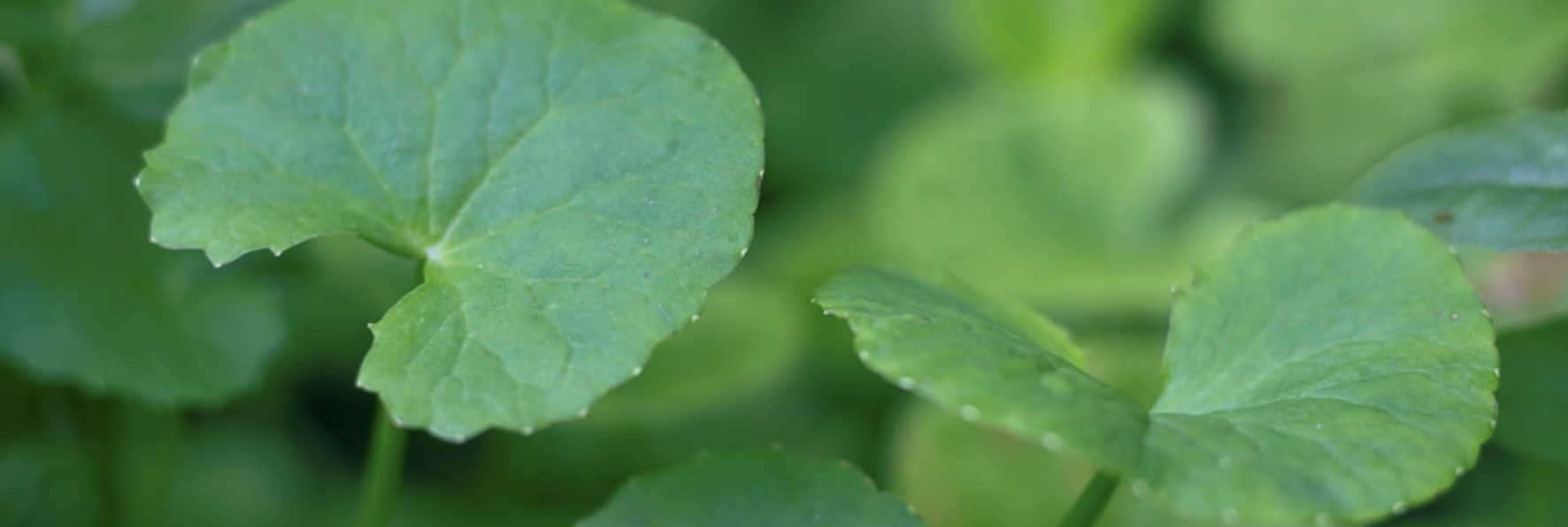
Every K-beauty moisturiser with a calming claim now lists centella asiatica somewhere on the ingredient panel. Most consumers read that as reassurance. Formulation experience suggests it should be read as a question — specifically: which fraction, at what concentration, standardised to what.
The Botanical Fraction Problem: What Centella Asiatica Extract Actually Contains
Centella asiatica is a small creeping herb that has been used in wound-healing contexts across South and Southeast Asian medicine for centuries. Its modern cosmetic reputation rests almost entirely on four triterpene compounds: asiaticoside, asiatic acid, madecassic acid, and madecassoside. These four molecules are collectively responsible for the barrier-supportive and anti-inflammatory effects attributed to centella in formulated products.
Here is where the label begins to mislead. When a product lists Centella Asiatica Extract — the formal INCI designation under EU Cosmetics Regulation EC 1223/2009 — it communicates nothing about the relative concentration of those four compounds. The extract is a botanical fraction, and botanical fractions are inherently variable. The ratio of asiaticoside to madecassoside shifts depending on which part of the plant was used (leaf versus whole herb), what solvent system was employed during extraction (water, ethanol, or a combination), and critically, whether the supplier has standardised the final material to a defined triterpene percentage.
Industry-grade centella extracts range from unstandardised aqueous preparations at perhaps 0.1–0.5% total triterpenoids to standardised TECA (Titrated Extract of Centella Asiatica) materials containing 40% total triterpenes, of which roughly 60% is asiaticoside and 30–40% is a combination of asiatic acid and madecassic acid. Madecassoside, notably, may be present at relatively low concentrations in many raw extract grades. A product containing 1% of an unstandardised centella extract delivers a meaningfully different dose of active compounds than a product containing 1% TECA — yet both carry an identical INCI declaration.
The INCI name tells you the plant. It does not tell you the chemistry. Those are not the same piece of information.
This is not a regulatory failure in the narrow sense — EC 1223/2009 requires that ingredients be listed by their standardised INCI name, which for botanical extracts refers to the plant of origin, not the phytochemical profile. The regulation is designed for safety classification and consumer transparency regarding allergens and prohibited substances. It was never designed to communicate bioactive standardisation. The gap between those two purposes is where consumer confusion enters.
| Compound | Type | Primary Skin Mechanism | Typical % in Unstandardised Extract |
|---|---|---|---|
| Asiaticoside | Triterpene glycoside | Collagen synthesis stimulation, wound repair signalling | Variable, often dominant |
| Asiatic Acid | Triterpene aglycone | Antifibrotic activity, anti-inflammatory via NF-κB pathway | Low–moderate |
| Madecassic Acid | Triterpene aglycone | Collagen type I and III upregulation, anti-inflammatory | Low–moderate |
| Madecassoside | Triterpene glycoside | Targeted anti-inflammatory via cytokine modulation, barrier gene expression | Low; variable by cultivar and extraction |
Madecassoside: The Isolated Compound and Why Isolation Matters
Madecassoside is a triterpene glycoside — a sugar-bound form of madecassic acid. When a product lists Madecassoside by that specific INCI name, it signals something fundamentally different from centella extract: a single, isolated, chemically defined compound at a known purity level. This is the distinction that most consumer-facing content collapses, and the collapse has real consequences for product selection.
The glycoside structure of madecassoside — where madecassic acid is bound to a glucose-rhamnose sugar chain — affects its skin penetration behaviour relative to the free aglycone form. The sugar moiety makes the molecule more hydrophilic and moderately larger, which means it sits and functions primarily at the epidermal level rather than penetrating to dermal layers. This is not a limitation in most calming formulations; epidermal cytokine modulation and barrier gene support are precisely where the ingredient is most useful. For dermal collagen work, asiatic acid and asiaticoside are the more relevant fractions.
From a formulation perspective, madecassoside offers something that centella extract cannot: reproducibility. When a Korean cosmetic manufacturer sources madecassoside at 0.1% active in a serum, the anti-inflammatory dose is known and consistent across production batches. When the same manufacturer formulates with 2% centella asiatica extract from a botanical supplier, the madecassoside content in that 2% is a function of the supplier’s harvest conditions, extraction parameters, and whether they chose to standardise the output. That variability is invisible on the finished label — in both the Korean market and, by extension, under EU import compliance.
Reproducibility is not a minor technical detail. It is the condition under which clinical evidence becomes applicable to a commercial product.
Mechanism Comparison: How Each Form Acts on Skin Tissue
Understanding why centella extract and isolated madecassoside produce different results requires a brief look at how each interacts with keratinocyte and fibroblast biology.
Anti-Inflammatory Pathway
Madecassoside has been shown in controlled in vitro studies to suppress NF-κB nuclear translocation in UVB-stimulated keratinocytes and to reduce secretion of IL-1β, IL-6, and TNF-α in lipopolysaccharide-activated macrophage models. This is a relatively specific anti-inflammatory action. The molecule interacts with inflammatory signalling at a defined pathway node, which is why the results in standardised studies are consistent and replicable.
Centella asiatica extract, by contrast, delivers a broader — and less predictable — mixture of signals. Asiaticoside activates TGF-β1 pathways that drive fibroblast proliferation and collagen synthesis. Asiatic acid suppresses NF-κB via a mechanism partially overlapping with madecassoside but through aglycone-specific interactions. Madecassic acid has demonstrated antifibrotic properties in hepatic models, with emerging evidence for analogous effects in dermal tissue. The result is that a well-formulated, well-standardised centella extract can be genuinely multi-functional — but “well-standardised” is doing considerable work in that sentence, and the label does not tell you whether those conditions were met.
Barrier Support and Aquaporin Expression
One of madecassoside’s more practically relevant mechanisms for European skin is its effect on aquaporin-3 (AQP3) expression. AQP3 is a membrane-channel protein in keratinocytes responsible for transporting water and glycerol across the epidermal cell membrane. Studies have demonstrated that madecassoside at concentrations as low as 0.05% can upregulate AQP3 gene expression in human keratinocyte cell lines, supporting transepidermal water retention by enhancing the cell’s own water-handling capacity.
This mechanism is distinct from occlusive or humectant hydration and represents a more structural form of barrier support — one that becomes particularly relevant in the low-humidity indoor environments typical of European winters, where passive evaporation pressure on the epidermis is higher than the skin evolved to manage efficiently. Whether a centella extract delivers a meaningful dose of madecassoside to activate this pathway depends entirely on standardisation factors the label will not disclose.
A note on study translation: Much of the in vitro evidence for madecassoside’s mechanisms uses isolated compound at defined concentrations. When evaluating clinical claims made for centella extract products, it is worth asking whether the referenced study used isolated madecassoside, a standardised TECA extract, or an unstandardised botanical fraction — and whether the concentration in the study product matches what appears in the commercial formulation. These are rarely equivalent situations.
European Skin Context — Hard Water, Low Humidity, and Barrier Stress
The case for being precise about centella versus madecassoside becomes more concrete when you consider the specific barrier stressors facing skin in northern and central Europe. This is not a generalisation about “sensitive skin” — it is an environmental chemistry point.
Tap water hardness in cities like Berlin, Amsterdam, and London commonly registers between 300 and 400 mg/L total dissolved solids, with calcium and magnesium ions forming the dominant mineral load. These divalent cations interact with surfactant residues on skin, forming insoluble soaps that deposit on the stratum corneum surface and alter its permeability characteristics. Repeated exposure — which is simply what daily face-washing involves — degrades ceramide organisation in the lipid bilayer and elevates transepidermal water loss (TEWL) over time. The inflammation associated with this chronic low-grade disruption is precisely the category that centella-type ingredients are positioned to address.
Winter indoor heating compounds this further. Central heating reduces indoor relative humidity to the 20–40% range across much of Germany, the Netherlands, and the UK from October through March. At those humidity levels, the concentration gradient driving water from the epidermis into ambient air is steep enough to measurably increase TEWL within hours of being in a heated indoor environment, even in individuals without diagnosed sensitivity conditions.
For a European consumer managing this combination of hard-water contact and low-humidity evaporative stress, the distinction between a calming ingredient with demonstrated AQP3-upregulation capacity (madecassoside) and a botanical fraction with uncertain triterpene content is not academic. It shapes whether a product addresses the mechanism of barrier disruption or simply provides temporary surface comfort through other formulation components like glycerin or niacinamide.
It is also worth noting that the EU’s approach to cosmetic ingredient regulation under EC 1223/2009 does not require manufacturers to disclose the active standardisation of botanical extracts — only that the ingredient is present and listed in descending order of concentration. A product with centella asiatica extract listed third on the INCI, behind water and glycerin, could contain anywhere from 0.5% to 5% of that extract depending on formulation intent, and within that range, the effective madecassoside dose could vary by an order of magnitude.
Hard water and dry indoor air are not a skin type. They are a chemical environment — and they require ingredients with defined mechanisms, not loosely standardised botanical approximations.
Reading the Label Practically: What to Look for on an INCI List
None of this means that centella asiatica extract is a weak or unreliable ingredient. Standardised TECA grades and high-quality Korean botanical suppliers have produced very consistent materials for decades. The problem is that the label alone cannot distinguish between those materials and a less rigorous unstandardised extract — and most consumer guidance does not equip readers to ask the right questions.
Signals That Suggest Better Standardisation
When evaluating a K-beauty product for centella content, a few label signals are worth looking for. First, the presence of Madecassoside as a separate INCI entry alongside Centella Asiatica Extract suggests the brand has chosen to supplement the broad botanical fraction with a defined amount of isolated compound — a formulation approach that reflects awareness of the standardisation gap and a desire to close it. This is not uncommon in mid-to-premium Korean formulations and represents a considered technical decision.
Second, some brands include the term “CICA” informally — a marketing abbreviation for centella — while others specifically reference “Madecassoside” in their product claims. These two terms should now carry different weight for an informed reader. “CICA” tells you the plant source. “Madecassoside” tells you something about the chemistry.
Third, position on the INCI list matters. Ingredients are listed in descending concentration order under EU labelling rules. Centella asiatica extract appearing in the top five to seven ingredients suggests a higher-than-cosmetic-footnote concentration. Madecassoside appearing before the 1% threshold marker (which in EU-compliant listings often corresponds to the point where preservatives and minor actives appear) suggests a meaningful functional dose — typically 0.05–0.1% or higher.
What the Brand’s Formulation Language Signals
Brands that understand the centella versus madecassoside distinction tend to communicate differently about their products. They reference specific triterpene fractions in their product copy, they cite concentration percentages for isolated actives, and they distinguish between “soothing” effects (often associated with the broader extract) and “barrier repair” effects (more specifically associated with madecassoside’s AQP3 and cytokine pathways). Brands that use centella and madecassoside interchangeably in marketing copy are, charitably, not drawing on deep formulation knowledge.
For European consumers working through a K-beauty routine adapted for German or northern European conditions, this distinction becomes part of a broader practice of reading formulations rather than reading claims. It is the difference between understanding why a product should work for your specific barrier environment and trusting that the word “calming” on the front panel means something chemically coherent.
A useful cross-reference: products that combine centella asiatica extract with panthenol (provitamin B5) and niacinamide are layering multiple barrier-relevant mechanisms — the extract for potential triterpene activity, panthenol for keratinocyte proliferation support, and niacinamide for ceramide synthesis upregulation. The synergy is real, but it does not substitute for knowing whether the centella fraction in that particular formulation is delivering meaningful madecassoside content. Understanding how Korean moisturisers are formulated for ceramide delivery provides useful context here.
The most honest summary is this: centella asiatica extract is a complex botanical material with genuine potential across multiple skin-function mechanisms. Madecassoside is a specific molecule with a defined mechanism, a replicable dose, and a body of targeted research behind it. They are related but they are not interchangeable — and treating them as synonyms, as most product marketing currently does, leaves consumers selecting between products whose actual active profiles may differ substantially, with no reliable way to tell from the label alone.
All criteria above — Centella in first 8 ingredients, D-Panthenol at meaningful concentration, plant-derived Squalane — apply. Both platforms below carry EU-regulation-compliant formulations with no import issues.
Madecassoside Products:


Frequently Asked Questions
References
- Bylka W, et al. (2014). Centella asiatica in cosmetology. Postepy Dermatol Alergol. NCBI PubMed.
- Maquart FX, et al. (1999). Triterpenes from Centella asiatica stimulate extracellular matrix accumulation in rat experimental wounds. European Journal of Dermatology. NCBI PubMed.
- Xu Y, et al. (2019). Madecassoside inhibits lipopolysaccharide-induced inflammatory response in vitro and in vivo. NCBI PMC.
- Song EJ, et al. (2019). Madecassoside Upregulates Aquaporin-3 and -9 in Reconstructed Human Epidermis Model. International Journal of Molecular Sciences. PubMed.
- European Parliament and Council. Regulation (EC) No 1223/2009 on cosmetic products. EUR-Lex Official Journal of the European Union.
- European Commission CosIng Database — Cosmetics Ingredient Search. EC Growth.
- Somboonwong J, et al. (2012). Wound healing activities of different extracts of Centella asiatica in incision and burn wound models: an experimental animal study. BMC Complementary and Alternative Medicine. PubMed.
- Hashim P. (2011). Centella asiatica in food and beverage applications and its potential antioxidant and neuroprotective effect. International Food Research Journal. ScienceDirect.
** Affiliate disclosure: Links above are affiliate links. JJJOZ earns a small commission on qualifying purchases at no cost to you. Product selection is based on formulation criteria only — not commercial relationships with brands.
Related posts




Leave a Reply