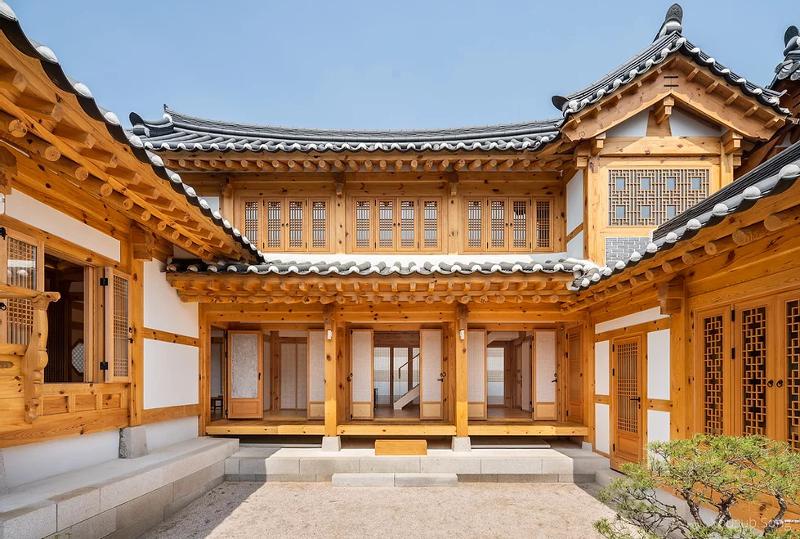

What Defines a Hanok
The roof is the first thing most people notice about a hanok. It is also the least interesting part of what the building is doing. The real logic of Korea’s traditional residential architecture is beneath the floor — and it has been solving problems that contemporary sustainable design is still working toward.
Hanok (한옥) means Korean traditional house — a term applied most precisely to private residential buildings, though the constructive logic extends to institutional architecture. What defines a hanok is not a fixed visual style but a construction system: wooden post-and-beam framing, a tiled or thatched roof, and a floor treatment that operates differently in summer and winter. That last element — two distinct floor systems for two opposite seasons — is the hanok’s most original contribution to residential design thinking, and it is where understanding needs to start.
Korea’s climate imposed genuinely extreme requirements on domestic architecture. Summer humidity in Seoul regularly exceeds 80%; winter temperatures drop below −10°C and stay there. A building that handles both conditions without mechanical assistance is not designing for a compromise between two extremes — it is designing two distinct technical solutions into the same structure and asking the occupant to switch between them seasonally.
Ondol and Maru: The Two-Floor Logic
The winter floor system is ondol (온돌) — a conduction-based underfloor heating architecture. Combustion heat generated in the kitchen furnace travels through sealed stone channels beneath the floor and exits through a chimney on the far side of the room. The stone floor itself becomes a radiant surface. In a functioning ondol room in winter, the floor is the warmest place in the space, and traditional Korean domestic life — sleeping, eating, working — organised itself accordingly, at floor level rather than at European chair-and-table height.
Spatial consequence: The warmest zone in the room is the floor, not the air column above it. This inverts the European heating logic, where heated air rises toward the ceiling and the floor remains the coldest surface. Traditional Korean sleeping, eating, and working arrangements followed the thermal logic — not cultural convention.
Contemporary relevance: Ondol is the direct predecessor of hydronic underfloor heating systems now standard in Scandinavian and German sustainable building practice. The thermal mass principle — storing heat in dense material and releasing it slowly — is the same. The Korean precedent predates European adoption of this logic by several centuries.
The summer solution is the maru (마루) — a raised wooden plank floor in an open or semi-open hall called the daecheong maru (대청마루). Where ondol retains and radiates heat, the maru releases it. The gap beneath the raised floor allows air movement; the open-sided orientation of the daecheong between rooms channels cross-ventilation. In a correctly sited hanok, the daecheong acts as a through-draft corridor that reduces interior temperatures without any mechanical assistance.
These two floor systems are not in tension. They are two distinct technical solutions occupying different parts of the same building — designed to alternate by season, not to compromise between two needs.

The Wooden Frame as a Structural Idea
The structural skeleton of a hanok is a wooden post-and-beam framework: vertical columns carry horizontal beams, which carry the roof structure. The assembly uses joinery — interlocking wood geometry — rather than metal fasteners. (For a parallel example of how Korean craft builds structure through layered material logic rather than surface decoration, read more about Najeon Chilgi here.) This is the load path. Everything else, crucially, is not.
Because the walls of a hanok are non-load-bearing — the frame carries the structure entirely — they can be made of lightweight materials, positioned variably, and opened or closed seasonally. The paper-covered lattice doors and windows that characterise hanok interiors are not decorative decisions. They are logical consequences of separating enclosure from support. You can remove or reposition a hanok room’s walls without compromising structural integrity. This is architecturally unusual and deliberately so: the building is designed to be reconfigured in response to season, occasion, and use.
| Region | Typical Plan Form | Climate Driver | Key Spatial Characteristic |
|---|---|---|---|
| Northern (Pyongan, Hamgyong) | ㅁ-shaped (closed) | Extreme cold winters, wind | Enclosed courtyard for heat retention; minimal openings; compact ceiling heights |
| Central (Seoul, Gyeonggi) | ㄷ-shaped (three-sided) | Cold winters, hot summers | Balanced between enclosure and ventilation; formal sarangchae/anchae separation |
| Southern (Jeolla, Gyeongnam) | ㄱ or linear | Milder winters, high summer humidity | Open maru spaces maximised; deep eaves for rain shelter; cross-ventilation priority |
Regional variants documented by AURI National Hanok Center. Floor plan shape is the most reliable indicator of regional origin before examining other evidence.
Reading the Floor Plan as a Social Document
The layout of an upper-class Joseon hanok is simultaneously a climate response and a social constitution. The building encodes the structure of the household it shelters — who has access to which spaces, on what occasions, under what conditions — as directly as it encodes the thermal logic.
In a formal yangban household, the sarangchae (사랑채) — the men’s outer quarters used for study and receiving guests — and the anchae (안채) — the inner quarters associated with women and domestic life — were not adjacent rooms. They were separate structures, connected only through gated passages. A guest in the sarangchae would not enter the inner compound. The madang (마당, courtyard) between these zones is not wasted space. It is the threshold and circulation space that mediates movement through a socially differentiated building. The plan makes the social hierarchy legible in spatial form.


The Sinhanok Question: What Transfers and What Does Not
Contemporary Korean architecture has produced sinhanok (신한옥, new hanok) — buildings that apply the traditional post-and-beam framework and visual vocabulary to current use patterns. Many have become cafés, galleries, and boutiques in Seoul’s Bukchon, Seochon, and Ikseon-dong districts. Seoul’s city government has published a formal typology of contemporary hanok categories, including designations for alley hanok, courtyard-centred hanok, and residential-commercial hybrid types.
The critique — that café conversions hollow out the architectural form’s cultural meaning — is worth taking seriously. But it is not the only available reading. The more useful analytical question is which elements of the hanok’s design logic survive transfer to contemporary conditions and which do not. The structural principle — separating enclosure from load-bearing — transfers entirely and has real functional value in contemporary architecture. The thermal logic of ondol transfers almost directly into hydronic underfloor heating; the cross-ventilation logic of the daecheong transfers into contemporary passive cooling design. The social encoding of separate quarters for separate household members does not transfer — and the buildings that are most interesting tend to be the ones that are honest about which logic they are continuing and which they are setting aside.

Working in product development and design across Korea and Europe, the element of hanok that I have found most consistently underestimated by European designers is the non-load-bearing wall. The European building tradition — masonry, concrete, structural walls — produces an instinct to read walls as fixed and defining. In a hanok, the wall is a screen that can be moved. The spatial consequence is that the building is much more programmable than it looks from outside. You are not modifying a fixed container; you are reconfiguring a frame.
The thermal mass logic of ondol has become directly relevant to contemporary sustainable building practice in a way that is not always acknowledged. The principle — store heat in dense material during periods of combustion, release it slowly over hours — is exactly what passive house design is trying to achieve with concrete floor slabs and phase-change materials. Korean residential architecture was doing this with stone and clay for centuries. The technical inheritance is real, even if the cultural one is more complicated.
What I notice in the sinhanok discussion is a gap between the buildings that are formally praised and the buildings that are actually well-occupied. The most praised often foreground the visual vocabulary — the curved eave, the tiled roof. The best-occupied tend to foreground the spatial intelligence — the relationship between interior and courtyard, the ability to open or close the building to the outside. That gap tells you something about where the architecture’s actual value is located.
References
- Seoul Hanok Portal — hanok.seoul.go.kr — City government documentation of hanok typology, sinhanok categories, and conservation policy.
- AURI (Architecture & Urban Research Institute) — National Hanok Center — Research documentation on regional hanok variants, floor plan analysis, and contemporary hanok design criteria.
- National Folk Museum of Korea (국립민속박물관) — Historical archive of domestic material culture, ondol and maru documentation, social use of hanok space.
- Kim, Bong-ryol. Hanok: The Korean House. Seoul: Hollym, 2010. — Structural analysis of hanok construction logic with comparative regional documentation.
- Korea Craft & Design Foundation (KCDF) — Contemporary craft and design applications of traditional Korean construction and material principles.



Leave a Reply