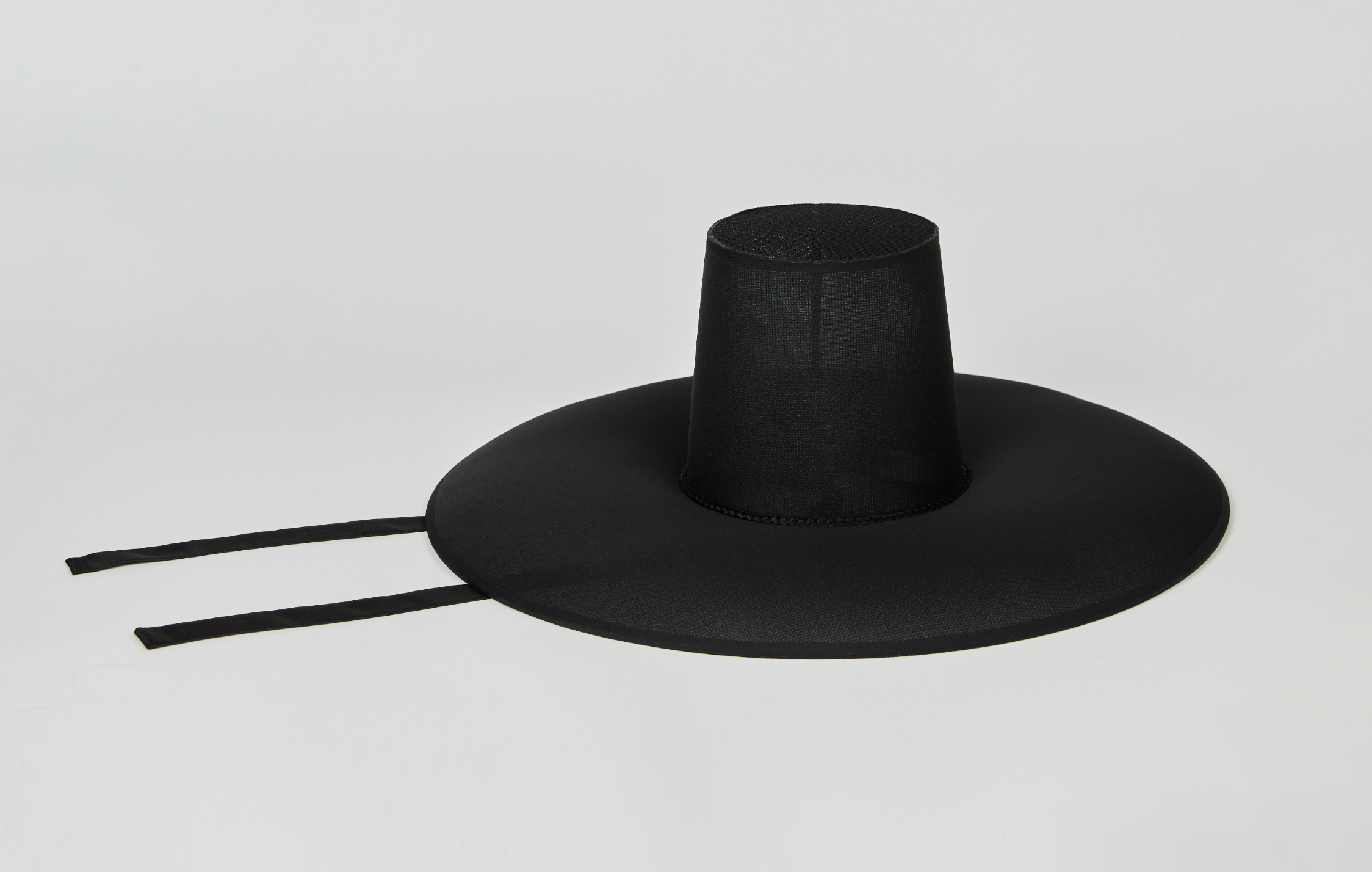
Pick up a traditional Korean gat and the first thing you notice is what is absent: weight. An object that reads visually as structured, formal, and precise is almost nothing in the hand. That gap between apparent mass and actual mass is not incidental — it is the design problem the gat was built to solve.
The gat (갓) is the traditional formal hat most associated with Joseon-period (1392–1910) Korean male dress. Its profile — a cylindrical crown (daewu, 대우) rising above a wide horizontal brim (yangtae, 양태) — is one of the most visually distinctive silhouettes in Korean material culture. The profile was not an aesthetic starting point. It was the result of specific material constraints, a defined social function, and a craft system that developed highly specialised techniques for each component of the object separately.
Understanding what the gat is doing as an object requires working through the materials before the meaning. The meaning — what headgear communicated in Joseon social space, and how the gat’s specific form embodied the visual logic of a class — follows from understanding how the object was constructed. The construction is what makes the meaning possible.
Three Materials, One Object
Dimensional precision: The brim-shaping step — mo jabgi (모 잡기), literally “catching the shape” — used applied heat to fix the brim’s compound curve. The precision required is visible in completed objects: a well-made gat brim holds an even projection from the crown on all sides, reading as stable and resolved rather than tentative. Achieving this geometry through heat-forming rather than moulding requires tactile calibration that does not transfer easily through documentation.
Weight consequence: The split bamboo framework is so fine that the brim of a completed gat is nearly weightless despite spanning 30–40 cm across. The structural adequacy is achieved through geometric efficiency — the curve carries load — rather than material mass.
Structural contribution: The woven horsehair surface, once lacquered, holds its own form. It is not a drape over the bamboo skeleton; it is a semi-rigid shell that contributes to the object’s structural integrity. The bamboo provides the primary skeleton; the horsehair surface stiffens and unifies it.
Transparency as design element: The partial transparency of the horsehair surface means the gat reads differently against different backgrounds. Against sky, the brim shows its depth rather than its surface. Against dark interiors, the lacquer finish dominates. The object is not optically fixed — it changes register with its environment.
Layered effect: The combination of lacquer over translucent horsehair produces a surface that reads as unified black from a distance but reveals layered depth at close range— a material logic comparable to Korean lacquerware systems where depth is constructed through layered surface rather than applied decoration. (Read more about this approach in traditional Korean mother-of-pearl lacquerwork here.) The glossy lacquer surface sits above the semi-transparent horsehair structure, which sits above the bamboo skeleton. Each layer is visible within the unified whole.

The Division of Labour as a Design System
Traditional gat-making was not the work of a single artisan. It was organised as a series of distinct specialisations: bamboo framework preparation, horsehair weaving, crown-forming, brim-shaping, lacquer finishing. These were separate skills, and in the Joseon-period production centres, they were practised by different people. The object was assembled across a division of labour in which each specialist was responsible for one component of the whole.
This structure has a direct implication for the object’s survival as a craft. The loss of any single specialisation in the production chain threatens the full object. You cannot reconstitute the gat by finding one generalist — you need all the specialists. The current designation of gat-making as a Korean National Intangible Cultural Heritage specifically acknowledges this: the protection is not of the object but of the transmission of the component skills that make the object possible.
The craft system is a design decision, not just a production organisation. What the gat looks like is inseparable from how it was made — and how it was made required maintaining multiple distinct skills simultaneously.
The Gat as Visual Communication System
In Joseon society, headgear was not optional and not neutral. Hat type indicated sex, social class, occupation, marital status, and occasion simultaneously. The formal heuklip (흑립) — the black lacquered horsehair gat — was specifically associated with the yangban (양반) scholar-official class in formal and semi-formal contexts. The brim width, crown height, crown diameter, and finishing details all varied according to status level and occasion type within that broad category.
The design brief of the gat therefore included requirements that go well beyond comfort and weather protection. The object needed to signal status at a distance, hold its form through a full working day in varied conditions, and do so at near-zero weight. The material solution — transparent horsehair over a bamboo skeleton under lacquer — was not aesthetically motivated. It was the most efficient available answer to a set of functional requirements that included visual clarity, structural integrity, social legibility, and minimal mass.


From an accessory design background, the gat is the Korean material culture object I return to most often when thinking about structural efficiency. The specific problem it solves — visible rigidity at near-zero weight, achieved without any structural material that is not also doing surface work — is a design problem that contemporary accessory designers still find difficult. The solution (woven semi-rigid fibre over a minimal skeleton, unified by a sealing finish) is elegant in the engineering sense: minimal means, maximum result, no redundant elements.
The transparency property is the element that most directly challenges European accessory design assumptions. European formal headgear — top hat, trilby, beret — is optimised for opacity. The surface is a surface; what is behind it is the lining. The gat is designed around the quality of its depth, not its surface. The lacquer finish and the horsehair structure are visible simultaneously, at the same moment. That is a fundamentally different visual logic, and it requires a different material approach to achieve.
The division-of-labour structure also raises a question that is relevant beyond traditional craft: when an object requires multiple distinct skills to produce, those skills are vulnerable individually. Maintaining a complex craft means maintaining an entire ecosystem of competences, not just the knowledge of the final assembly. The gat’s heritage designation understood this. Most contemporary craft preservation programs do not.
References
- National Folk Museum of Korea (국립민속박물관) — Collection documentation of Joseon-period headgear, social function classification, and material analysis.
- Academy of Korean Studies (한국학중앙연구원) — Scholarly archive on Joseon social hierarchy, dress codes, and material culture classification.
- National Intangible Cultural Heritage designation — Gat-making (갓일) official heritage designation and transmission programme documentation.
- K-Heritage Channel — Video documentation of gat production process including bamboo framework, horsehair weaving, and brim-shaping.
- Korean Cultural Heritage Foundation (한국문화재재단) — Object photography archive and traditional craft documentation.



Leave a Reply