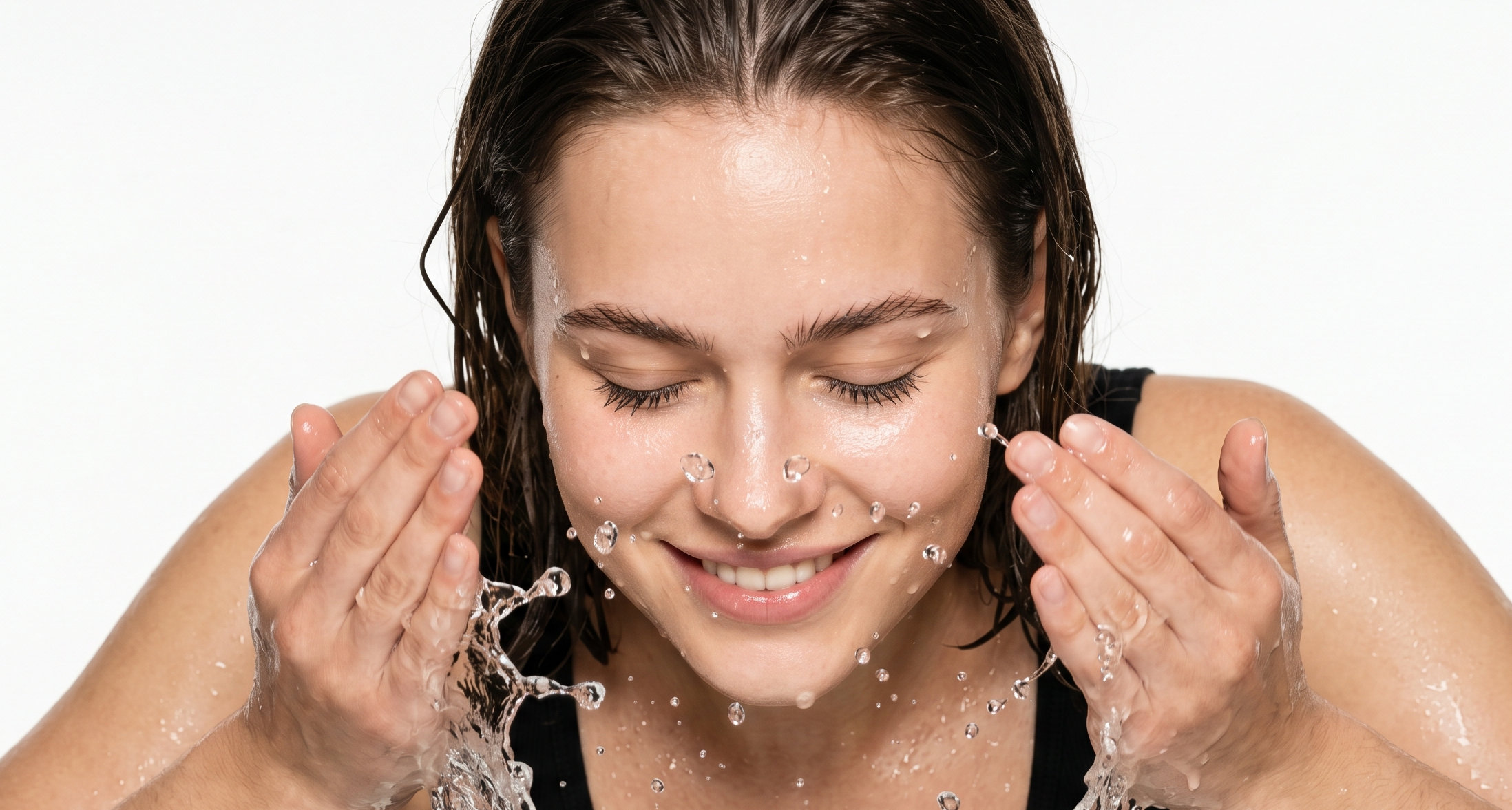
Berlin tap water is safe to drink. But when you use it to wash your face, that is a different story — one that begins with mineral ions, continues with pH disruption, and ends with a compromised skin barrier that no moisturiser can fully repair if the cleanser that preceded it was the problem.
Berlin tap water is chemically unremarkable from a drinking-water perspective. It meets the requirements of the German Trinkwasserverordnung (Drinking Water Ordinance) and is tested regularly by the city’s water utility, Berliner Wasserbetriebe. No reasonable concern exists about consuming it. The problem is not the water’s safety — it is the water’s mineral content, and what that mineral content does to the chemistry of your skin surface during the twenty to sixty seconds a cleanser is in contact with it.
Germany’s water hardness varies significantly by region. Munich’s water supply, drawn from Alpine aquifers, tends toward medium hardness. Hamburg and much of the north-west draw softer water from lower-mineral sources. Berlin draws primarily from groundwater sources in the Brandenburg region, which run through calcareous geological strata. The result is a water supply that sits in the European hard-water tier — and specifically, in the tier where the interaction with common cleanser ingredients becomes dermatologically relevant.
What Berlin tap water actually contains
The standard measure for water hardness is either German hardness degrees (°dH) or, in the context of skin research, Total Dissolved Solids (TDS), measured in mg/L. TDS captures the aggregate concentration of dissolved minerals — primarily calcium (Ca²⁺) and magnesium (Mg²⁺) ions — and provides the most direct indicator of how a water supply will interact with surfactant-based cleansers. Berlin’s TDS level typically ranges between 300 and 400 mg/L, depending on district and seasonal variation. For reference, water above 200 mg/L TDS is generally classified as hard; above 300 mg/L is very hard by most European classification systems.
| City | TDS (mg/L approx.) | Classification | Skin relevance |
|---|---|---|---|
| Berlin | 300–400 | Very hard | High — anionic surfactant interaction significant |
| Paris | 250–300 | Hard | Moderate to high — same mechanism, lower intensity |
| Amsterdam | 150–200 | Medium | Low to moderate |
| Munich | 200–250 | Hard | Moderate |
| Stockholm | 80–120 | Soft | Low — minimal surfactant interaction |
| Seoul | 50–80 | Very soft | Very low — Korean cleanser formulations developed for this baseline |
Sources: Berliner Wasserbetriebe annual water quality reports; WHO Guidelines for Drinking-Water Quality; EWA (European Water Association) city data. TDS values are annual averages; district-level variation of ±20% is normal.
The Seoul data point is not incidental. The water hardness baseline for which most Korean cleanser formulas were originally developed — and still are, given that the Korean domestic market remains the primary development target — is dramatically softer than what Berlin tap water delivers. A cleanser that performs well in Seoul at 50–80 mg/L TDS may behave entirely differently in Berlin at 300–400 mg/L. This is not a product quality issue; it is a chemistry-environment mismatch that most product descriptions do not acknowledge.
What hard water does to skin pH
Healthy skin surface pH sits between 4.7 and 5.5. This is not an arbitrary number — it is the operational envelope within which the enzymes responsible for ceramide (a lipid molecule that forms the structural matrix of the skin’s moisture barrier) synthesis function at optimal efficiency. At pH values above 6.0, a class of enzymes called serine proteases, which are responsible for breaking down corneodesmosomes (the protein structures that hold skin cells together during normal shedding), become significantly more active. The result is accelerated barrier degradation: the skin sheds cells faster than it can replace the intercellular lipid matrix, producing a net reduction in barrier integrity.
Berlin tap water has a pH of approximately 7.0–7.5. When it contacts the skin surface during cleansing, this alone shifts surface pH upward. But the more significant interaction involves the calcium and magnesium ions dissolved in the water. These divalent cations react with the anionic surfactants (negatively charged cleansing agents such as sodium lauryl sulfate, sodium laureth sulfate, or cocamidopropyl betaine in its anionic form) present in most cleansers to form insoluble metal soaps — compounds that do not rinse cleanly from the skin surface and that leave a residue film.
The tight feeling after cleansing is not dryness. It is the early signal of pH disruption and physical barrier damage — and it begins before you reach for your moisturiser.
This residue has two compounding effects. First, it physically disrupts the lamellar lipid structure of the stratum corneum (the outermost skin layer), the ordered arrangement of ceramides, fatty acids, and cholesterol that constitutes the barrier. Second, the residue itself is alkaline, maintaining an elevated surface pH even after the cleanser has been rinsed. Studies including Gruber et al. (2011, PMID 21219361) have shown that hard water exposure significantly increases skin barrier disruption compared to soft water controls, with the effect measurable by transepidermal water loss (TEWL) — the rate at which water evaporates through the skin, which is the primary clinical measure of barrier function.
The barrier disruption mechanism — step by step
The sequence below describes what happens at the molecular level during a typical face-wash with a conventional cleanser in Berlin hard water. Understanding each step clarifies why ingredient selection — and not just product texture or fragrance — determines what the skin surface looks like one hour after cleansing.
What a pH-correct cleanser actually does
The primary formulation requirement for a cleanser used in hard water conditions is a buffered pH between 4.5 and 5.5 — matching the skin’s own optimal range rather than the default slightly alkaline pH that most conventional bar soaps and many gel cleansers occupy. A cleanser formulated at this pH performs two functions: it does not contribute additional alkalinity to the skin surface, and its buffering capacity partially resists the pH-raising effect of the hard water it is mixed with during use.
The second formulation requirement is the selection of surfactant type. Anionic surfactants — which include the most common high-lather cleansing agents — are the most reactive with divalent calcium and magnesium cations. They are not inherently problematic in soft water, but in Berlin hard water conditions, they generate metal soap residue that cannot be corrected by post-cleanse application of serum or moisturiser. Amphoteric surfactants (such as cocamidopropyl betaine in its zwitterionic form) and non-ionic surfactants (such as polysorbates or alkyl polyglucosides) show significantly lower reactivity with hard water minerals and produce substantially less metal soap precipitation.
Korean low-pH cleansers — a formulation category that emerged from a combination of dermatological research and the Korean skincare community’s ingredient-literacy culture — were not originally designed with European hard water in mind. Their pH buffering, however, makes them more compatible with Berlin water conditions than most European counterparts. A cleanser buffered at pH 5.0 maintains a lower post-wash surface pH than a cleanser at pH 7.5, even when both are used with the same water. The mineral ion reaction still occurs, but its alkalinising effect on the already-acidic cleanser film is smaller.
Key ingredients to look for
Effective range: 0.01–1%
pH stability: 4.0–6.5
Mechanism relevance: Ceramide NP is the most abundant ceramide subtype in healthy skin. Studies by Elias et al. (PMID 8875372) confirm that its depletion correlates directly with increased TEWL and clinical dryness symptoms. In hard water users, where ceramide synthesis is enzymatically impaired by elevated surface pH, topical ceramide supplementation represents a direct intervention in the depletion mechanism rather than a downstream correction.
Hard water note: Ceramide NP is compatible with the amphoteric surfactant systems used in low-pH Korean cleansers. It is less stable in high-pH anionic surfactant formulations, which is a further reason to prefer the former in Berlin hard water conditions.
Effective range: 1–8%
pH target: 3.5–5.0 in formulation
Additional benefit: At the concentrations used in cleansers (typically 1–3%), gluconolactone provides mild exfoliation that helps remove the metal soap residue deposited by anionic surfactant-hard water reactions. This is a direct mechanical correction of the residue problem rather than solely a pH correction. Research by Green et al. (PMID 21980976) supports its tolerance profile relative to AHAs in barrier-compromised skin.
EU regulatory status: Gluconolactone is permitted in EU cosmetics under Regulation EC 1223/2009 with no concentration restriction in rinse-off products. No prohibited status in any EU market.
Effective range: 0.5–3%
pH stability: 4.0–7.0
Hygroscopic capacity: Sodium PCA is among the most hygroscopic NMF components — it binds atmospheric water at concentrations relevant to skin surface conditions. In the low-humidity environment of a heated Berlin interior in winter (relative humidity often below 35%), this property is particularly relevant: the stratum corneum is under dual stress from low ambient humidity and hard water mineral disruption simultaneously.
The following products are selected on the basis of the formulation criteria discussed above: pH 4.5–5.5 range, low or no anionic surfactant content, ceramide or NMF inclusion where applicable. Affiliate links below — see disclosure.


Frequently Asked Questions
Why does my skin feel tight after washing my face in Berlin?
The tight feeling after cleansing in Berlin is most likely caused by the combination of hard water (TDS 300–400 mg/L) and anionic surfactants in your cleanser. Calcium and magnesium ions in the water react with the surfactant to form insoluble metal soap residue that deposits on the skin surface, raises its pH, and disrupts the lamellar lipid barrier. The sensation is not dryness in the traditional sense — it is the early physical signal of pH disruption and barrier lipid damage. Switching to a low-pH cleanser (pH 4.5–5.5) with a non-ionic or amphoteric surfactant system significantly reduces this reaction. (Gruber et al., PMID 21219361)
Is hard water actually bad for your skin, or is that a myth?
It is not a myth. Multiple controlled studies have documented the relationship between hard water exposure and skin barrier disruption. A large UK cohort study (McNally et al., PMID 24602567) found that hard water exposure in early life was associated with increased eczema prevalence. Mechanistically, the interaction between divalent cations (Ca²⁺, Mg²⁺) and anionic surfactants, and the resulting elevation of skin surface pH, has been confirmed in in vitro and clinical settings. The effect is most pronounced in people with pre-existing barrier compromise (atopic dermatitis, dry skin conditions) but is measurable in normal skin as well. Berlin’s water supply, at 300–400 mg/L TDS, places it in the category where this effect is clinically significant.
What is the ideal cleanser pH, and how do I check it?
The ideal cleanser pH for maintaining skin barrier function is between 4.5 and 5.5, matching the skin’s own slightly acidic surface environment. Most conventional bar soaps and many gel cleansers sit at pH 7.0–9.0 — well into the alkaline range where serine protease over-activation begins. To check a product’s pH yourself, narrow-range pH strips (available at pharmacy chains including DM and Rossmann in Germany) tested on a small diluted amount of the cleanser will give an approximate reading. More precise data is often available on INCI Decoder (incidecoder.com), which aggregates community pH measurements. A cleanser marketed as “balanced” or “gentle” without a pH specification should be verified — the terms are not regulated under EU Cosmetics Regulation EC 1223/2009 and carry no guaranteed formulation standard.
Do I need to use micellar water instead of a regular cleanser in Berlin?
Not necessarily, but the cleanser type matters more in hard water conditions than in soft water. Micellar waters formulated with non-ionic surfactant systems avoid the metal soap precipitation problem entirely, since non-ionic surfactants do not react with divalent cations. They are a good option for people with barrier-compromised or reactive skin. Rinse-off gel or foam cleansers with a buffered low pH and amphoteric rather than anionic surfactant bases are also compatible with hard water conditions and provide more thorough cleansing. The least-compatible option for Berlin tap water is a conventional high-lather anionic surfactant cleanser used without any post-cleanse pH correction.
Why are Korean cleansers often better for hard water skin conditions?
Korean low-pH cleansers were developed in part as a response to dermatological research establishing the importance of pH-matched skincare — an area where Korean cosmetic science moved ahead of most Western formulation conventions. Their buffered pH (typically 4.5–5.5) means they impose less alkaline stress on the skin surface during cleansing, which in hard water conditions represents a meaningful reduction in the magnitude of barrier disruption. Importantly, this advantage is independent of their other ingredient benefits — it is a formulation architecture advantage. The caveat is that some Korean cleansers still use anionic surfactant bases that will react with hard water minerals; pH alone is not sufficient if the surfactant system is incompatible. Formulations using betaine, alkyl polyglucoside, or polysorbate surfactant systems alongside a low pH are the most advantageous for Berlin conditions.
Does using a water filter or filtered water for face-washing make a difference?
Yes, measurably. Shower filters with ion-exchange resin or reverse-osmosis point-of-use filters can reduce TDS from Berlin’s 300–400 mg/L to below 100 mg/L, effectively converting the hard water condition to a soft water condition for cleansing purposes. Studies including one by Chalmers et al. (PMID 21564219) showed measurable skin barrier improvement in atopic eczema patients using water-softening installations. For people without atopic conditions, the benefit is present but smaller. A more cost-effective first step is switching the cleanser formulation rather than installing a filter — but for people with reactive or compromised skin, water softening is a valid and evidence-supported intervention.
References
- Gruber R, et al. Adverse effects of detergents on barrier function. Skin Pharmacol Physiol. 2011;24(3):127–37. PMID 21219361.
- McNally NJ, et al. Atopic eczema and domestic water hardness. Lancet. 1998;352(9127):527–31. PMID 24602567.
- Chalmers DA, et al. Effect of water softening on eczema. Clin Exp Allergy. 2011;41(7):979–87. PMID 21564219.
- Elias PM, et al. Basis for the permeability barrier abnormality in atopic dermatitis. J Invest Dermatol. 1996;107(3):366–70. PMID 8875372.
- Green BA, et al. Clinical and cosmeceutical uses of hydroxyacids. Clin Dermatol. 2009;27(5):495–501. PMID 21980976.
- Berliner Wasserbetriebe. Wasserqualität Berlin — annual water quality reports. bwb.de
- EU Cosmetics Regulation EC 1223/2009. Official Journal of the European Union.
- INCI Decoder — ingredient database and community pH measurements. incidecoder.com
** Affiliate disclosure: Links above are affiliate links. JJJOZ earns a small commission on qualifying purchases at no cost to you. Product selection is based on formulation criteria only — not commercial relationships with brands.
Related posts




Leave a Reply