
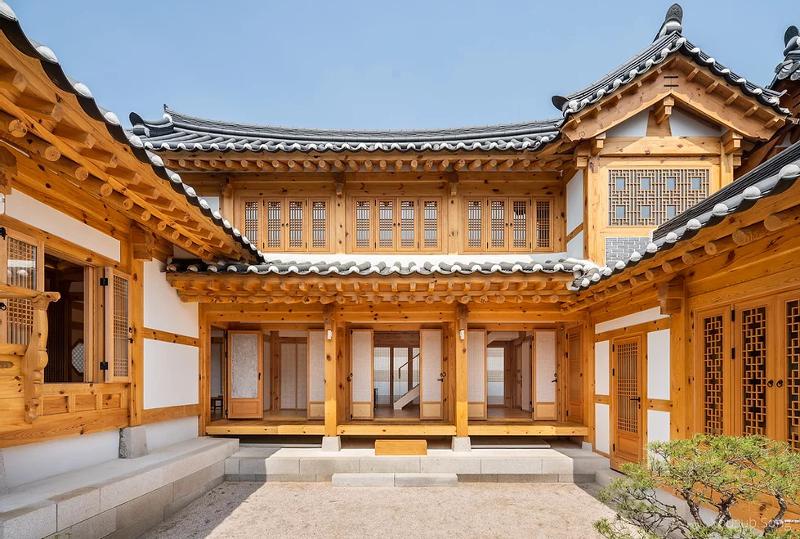
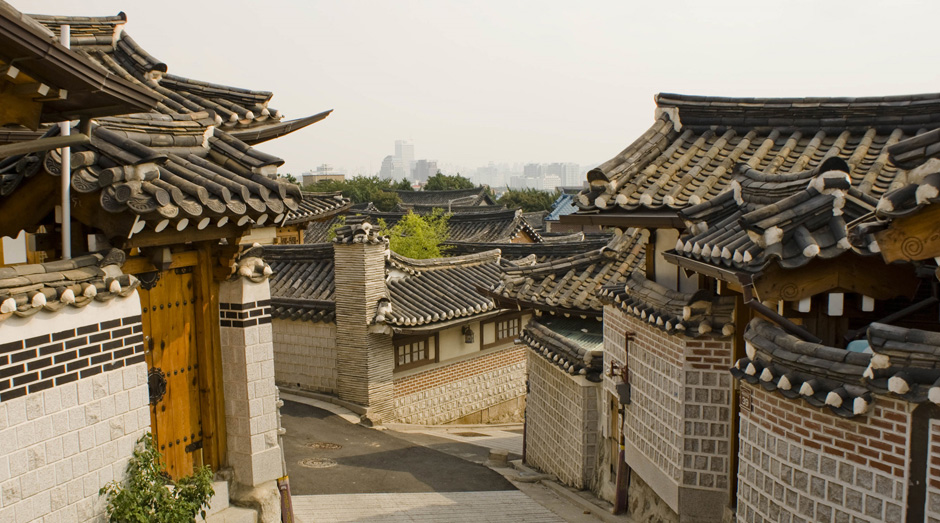
The first thing most people notice about a hanok is the roof — that distinctive upward curve at the eave tips, the grey of fired clay tiles against sky. But the roof is the least interesting part of the building’s logic. What makes hanok worth understanding as a design system is what happens underneath it: how the interior organises heat, airflow, family life, and social hierarchy into a single coordinated structure that was continuously adapted over centuries.
Hanok (한옥) simply means Korean traditional house — distinguished from the Western-style structures that began appearing in Korea in the late nineteenth century. The term is in practice applied most commonly to private residential buildings, though the formal principles extend to larger institutional architecture. What defines a hanok is not a single form but a construction system: wooden post-and-beam framing, a tiled or thatched roof, and a specific approach to floor treatment that differs fundamentally between summer and winter use.
Two Floor Systems for Two Opposite Seasons
Korea’s seasonal extremes — hot, humid summers and genuinely cold winters — drove an architectural response that most visitors miss because it is beneath their feet.
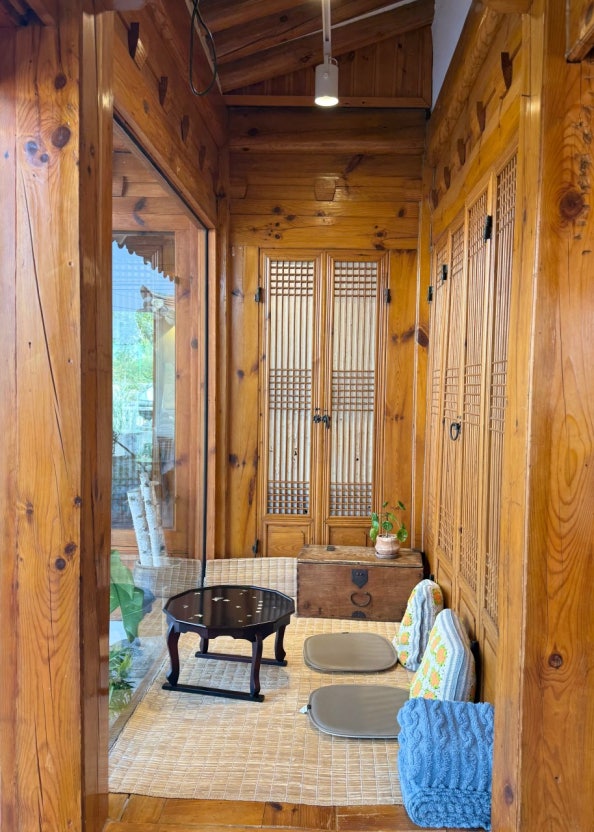
The winter solution is ondol (온돌), a conduction-based underfloor heating system. Heat generated in the kitchen furnace travels through sealed channels beneath the stone floor and exits through a chimney on the opposite side of the room. The floor itself becomes a radiator. In practice, this means that the warmest and most comfortable place in a hanok room in winter is the floor — and that traditional Korean domestic life (sleeping, eating, sitting, working) organised itself accordingly, at floor level rather than at chair and table height.
The summer solution is the maru (마루) — a raised wooden plank floor, typically in an open or semi-open hall called the daecheong maru (대청마루). Where ondol rooms retain heat, maru spaces release it. The gap beneath the raised floor allows air movement; the open orientation of the daecheong between rooms channels cross-ventilation. In a well-sited hanok, the daecheong in summer acts as a through-draft space that makes interior temperatures considerably more bearable without mechanical assistance.
These two systems — ondol floor for winter, maru floor for summer — are not in tension. They are designed to alternate. A hanok’s seasonal logic is not a compromise between competing needs; it is two distinct technical solutions occupying different parts of the same building.
The Wooden Frame and What It Does
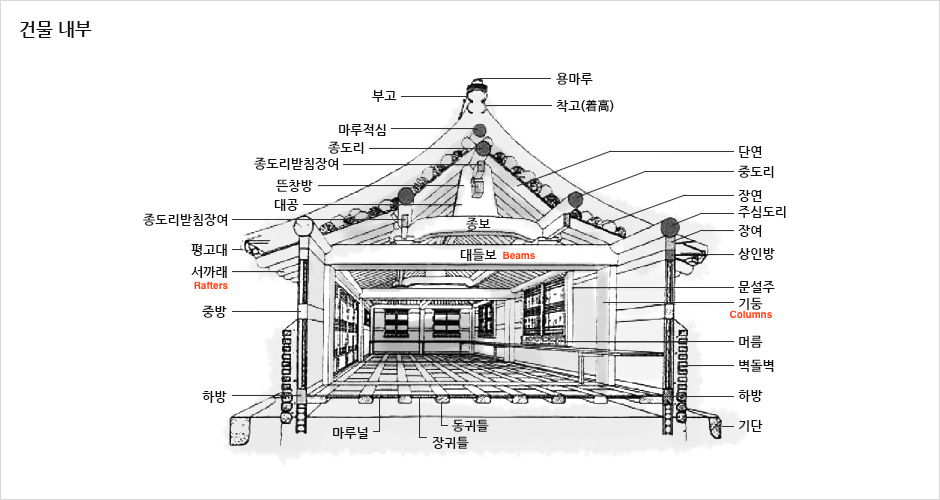
The structural skeleton of a hanok is a wooden post-and-beam framework: vertical columns, horizontal beams, and a roof structure assembled using joinery rather than fasteners. This framing carries the load of the roof and defines the building’s spatial organisation, but it also determines something less obvious — the building’s flexibility.
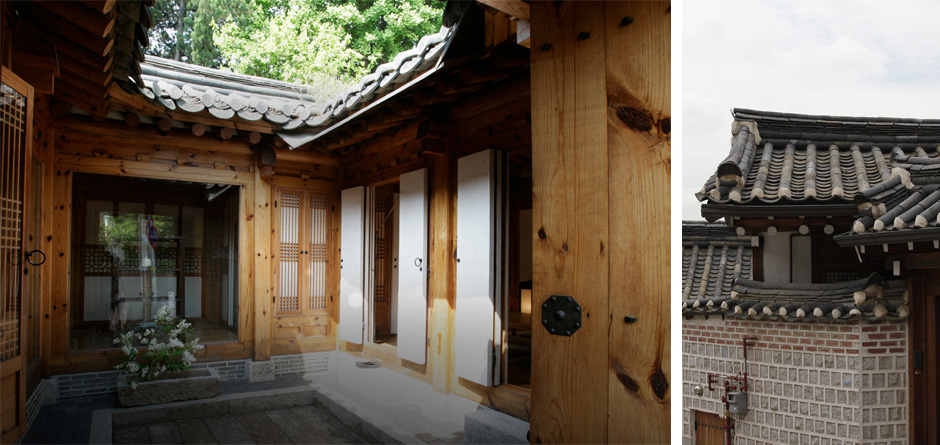
Because the walls of a hanok are generally non-load-bearing (the frame carries the structure), they can be made of lightweight materials, positioned variably, and opened or closed seasonally. The traditional sliding doors and paper-covered lattice windows that characterise hanok interiors are not decorative choices — they are consequences of a structural logic that separates enclosure from support. You can remove or reposition the walls of a hanok room in ways that are not possible in a masonry structure without compromising the building’s integrity.
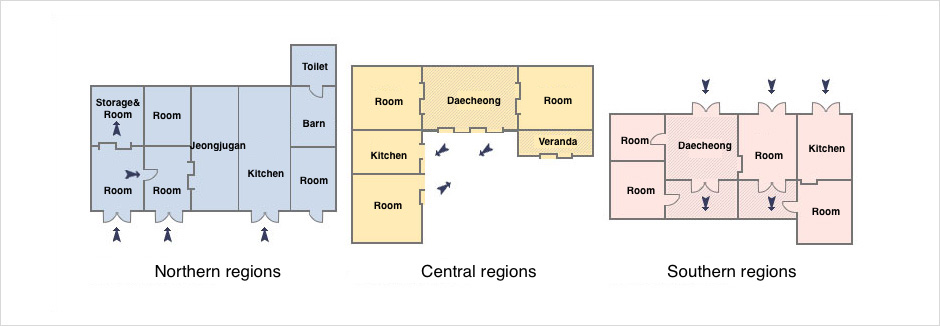
Regional climate differences produced different typical configurations within this shared framework. Buildings in the colder northern regions of the Korean peninsula tended toward enclosed layouts — rooms grouped around each other to retain shared heat, lower ceiling heights, smaller openings. Southern regional variants typically emphasised open maru spaces and greater cross-ventilation. Korean architectural historians have documented these regional types clearly enough that a building’s origin region is often identifiable from its floor plan, before looking at any other evidence.
Reading a Hanok Floor Plan as a Social Document
The layout of a hanok records the social structure of the household that built it as directly as it records the climate logic.
In upper-class Joseon-period households, the building was typically arranged as a series of distinct zones with controlled access between them. The sarangchae (사랑채) was the men’s quarters — used for study, receiving guests, and the social life of the household’s male members. The anchae (안채) was the inner quarters, primarily associated with women and family domestic life. These were not adjacent rooms but separate structures, often connected only through gated passages. A visitor to the household’s public spaces might never enter the inner compound.
This separation was not purely about gender — it also expressed the distinction between the household’s public presentation and its private interior life. The sarangchae was the face the household showed to the world; the anchae was where that household actually functioned day to day. Understanding this helps explain why so many hanok plans look, to contemporary eyes, like they contain more courtyard than interior space. The madang (마당) — the central courtyard — is not wasted area. It is the threshold between zones, the circulation space that mediates movement through a socially differentiated building.
The Plan Types and Their Consequences
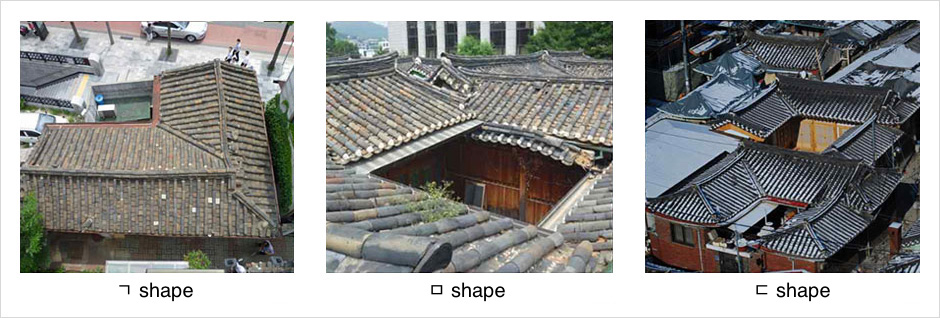
Korean architectural scholarship identifies several recurring hanok layout configurations, named after the Korean letters they resemble when seen from above.
The ㄱ-shaped plan creates an L-form building that typically generates a larger courtyard than the footprint would suggest — efficient where outdoor space is a priority. The ㄷ-shaped plan (open rectangle) surrounds the courtyard on three sides, providing better enclosure. The ㅁ-shaped plan (closed rectangle) encloses the courtyard on all four sides — a configuration common in colder northern regions where the internal environment needed the most protection from wind. The il-shaped (linear) plan is the simplest: rooms in a row, often with a long veranda connecting them.
What these configurations share is that the building is not conceived as a single object but as a system of relationships — between rooms, between inside and outside, between the household’s different social zones. The plan shapes the way people move through daily life: where they encounter each other, which paths they take, what they see and do not see. That level of intentionality in the organisation of domestic space is part of what makes hanok genuinely interesting to anyone thinking about how environments shape behaviour.
The Modern Hanok Question
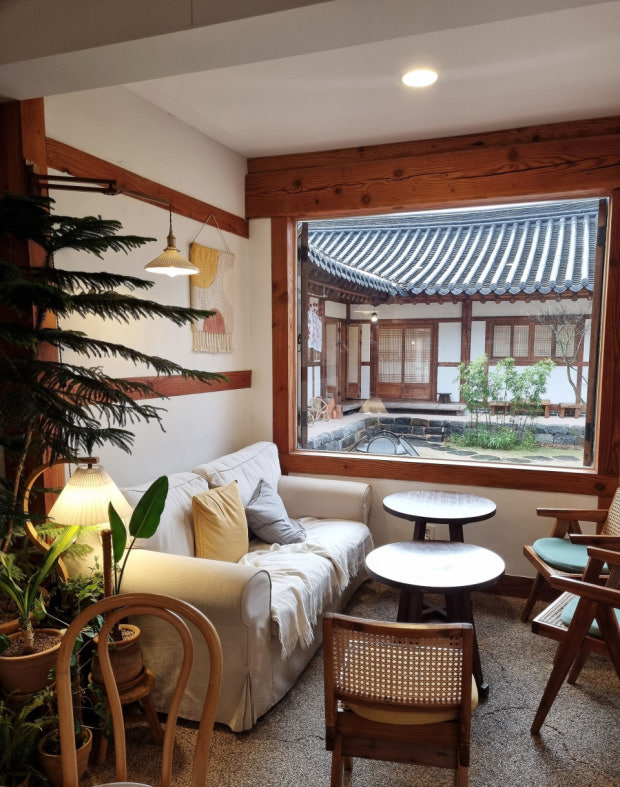
Contemporary Korean architecture has produced a category called sinhanok (신한옥) — literally “new hanok” — which applies the traditional post-and-beam wooden framework and visual vocabulary to buildings designed for current use patterns. Some sinhanok are residential; many have become cafés, galleries, boutiques, and guesthouses, particularly in Seoul neighbourhoods like Bukchon, Seochon, and Ikseon-dong where historic hanok concentrations survive within the modern city fabric.
The critique of this trend — that it commodifies heritage, that café conversions hollow out the cultural meaning of the architectural form — is worth taking seriously. But it is not the only available reading. Seoul’s city government has produced a detailed typology of contemporary hanok uses, including designations for golmok (alley) hanok, madang (courtyard-centred) hanok, and residential-commercial hybrid types. That level of formal attention to the building type’s contemporary evolution suggests something more than simple nostalgia.
What the most considered sinhanok projects tend to share is a fidelity to the structural logic of the original — the wooden frame, the distinction between load-bearing and enclosing elements, the relationship between interior and courtyard — even where the programme, materials, and aesthetic details are entirely contemporary. When that logic is abandoned in favour of surface styling (tiled roof and wooden screen applied to a concrete structure), the result is neither hanok nor something clearly new. The interesting design question is whether the spatial intelligence of the traditional type can survive transfer to contemporary conditions, and the answer varies considerably between examples.
Architecture references: Seoul Hanok Portal (hanok.seoul.go.kr); AURI National Hanok Center research documentation; National Folk Museum of Korea cultural archive. Historical social organisation referenced against Academy of Korean Studies (AKS) cultural scholarship.


 JJJOZ BLOG
Leave a comment