
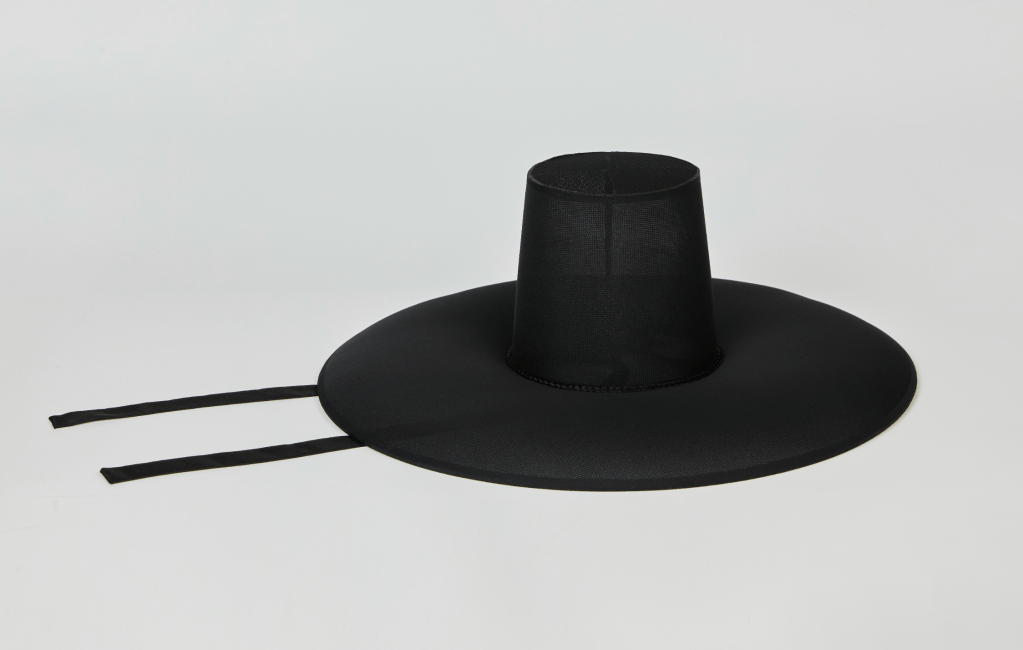
Pick up a traditional Korean gat (갓) and the first thing you notice is the weight — or rather the absence of it. An object that reads visually as substantial, formal, and complex is almost nothing in the hand. The brim is wide but nearly weightless. The crown is structured but transparent. The black finish is deep and glossy but applied over a surface you could press through with a finger. That combination — visible rigidity achieved through minimal material — is the central design problem the gat solves, and the solution is one of the more technically interesting things in Korean material culture.
The gat is the traditional formal hat most closely associated with Joseon-period (1392–1910) Korean male dress. Its distinctive profile — a cylindrical crown (daewu, 대우) rising above a wide horizontal brim (yangtae, 양태) — was not an arbitrary aesthetic choice but the result of specific material constraints, social functions, and a craft system that developed specialised techniques for each component of the object.
The Material Logic: Horsehair Over Bamboo
The structural core of a traditional gat uses two materials: thin-split bamboo for the framework and woven horsehair for the surface. Neither is intuitive as a hatmaking material, and the combination is less intuitive still — until you understand what each is doing.
Bamboo, split and processed to very fine strips, provides the structural skeleton of both crown and brim. The brim in particular requires a framework that can hold a wide, flat, slightly curved plane without sagging under its own weight or under the weight of rain. Bamboo achieves this with less material mass than any alternative available in the Korean material economy of the period.
Horsehair — woven into a tight textile — provides the outer surface. Horsehair has specific properties that make it unusually suited to this application: it is fine enough to weave tightly, stiff enough to hold structure without backing, and semi-transparent in thin layers. That last quality is the one that most distinguishes the gat aesthetically. A well-made horsehair surface is not opaque. Light passes through it partially, producing a depth in the surface that is visible but not quite locatable — you can see into the material slightly without seeing through it entirely.
The finishing process applies lacquer — historically a black lacquer that sealed the horsehair surface, deepened the colour, and provided the glossy finish that characterises formal gat. Silk was incorporated in finishing elements, including the tie cords and interior fittings. The result is an object whose surface reads as unified black but whose depth comes from the layered transparency beneath the finish.
The Craft System: Division of Labour by Component
What makes the gat’s production unusual is that it was not typically the work of a single artisan. Traditional gat-making was organised as a series of distinct specialisations: the bamboo framework preparation, the horsehair weaving, the crown-forming, the brim-shaping, the lacquer application and finishing. These were separate craft skills, and in the Joseon-period centres of hat production, they were practised by different people.
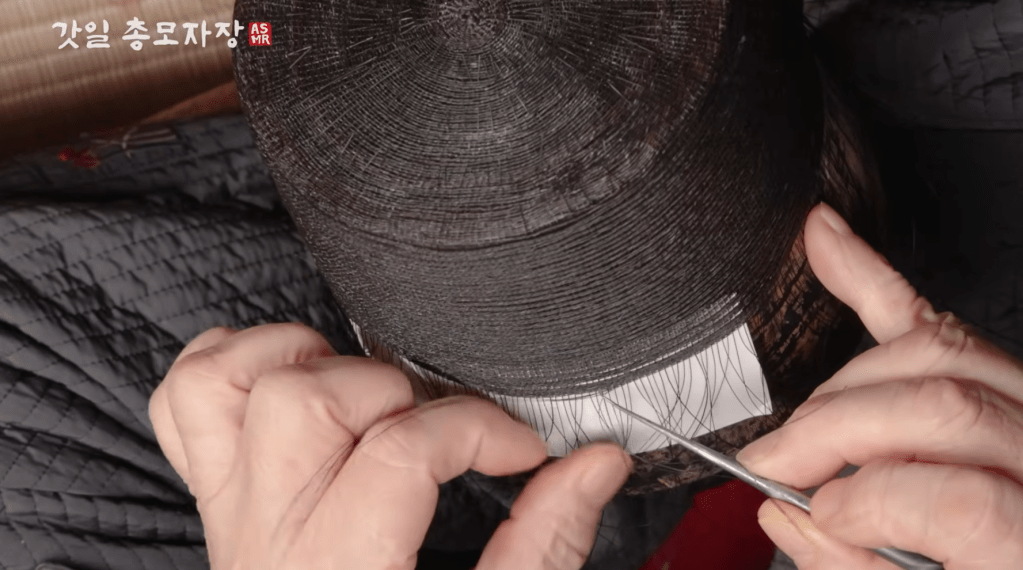
The brim-shaping step — called mo jabgi (모 잡기), literally “catching the shape” — involved applying heat to fix the brim’s curve. The precision required here is visible in completed objects: the brim of a well-made gat holds a specific compound curve that is both functional (it projects evenly from the crown on all sides) and visually resolved (it reads as confident and stable rather than tentative). Achieving that curve consistently across an object made from woven hair and split bamboo, through heat-forming rather than moulding, requires a level of tactile calibration that does not transfer easily through documentation.
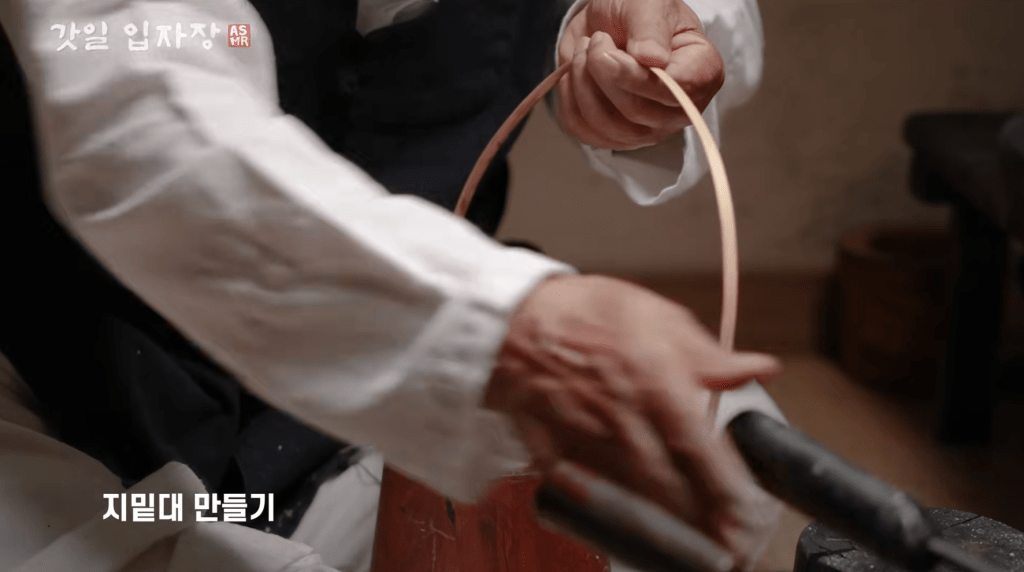
The craft is currently protected as a Korean National Intangible Cultural Heritage, with formally designated practitioners maintaining and transmitting the techniques. The survival of this designation matters in a practical sense: the division-of-labour structure that historically supported gat-making means that the loss of any single specialised skill threatens the full object. Reconstituting a craft system after its disruption is considerably harder than maintaining it.
The Gat as Visual Communication
In Joseon society, headgear was not optional and not neutral. The hat you wore indicated your sex, your status within the social hierarchy, your occupation if you held a formal role, your marital status, and the occasion you were dressing for. The formal heuklip (흑립) — the lacquered black horsehair gat most familiar from historical painting and drama — was specifically associated with the yangban (양반) scholar-official class in formal and semi-formal contexts.
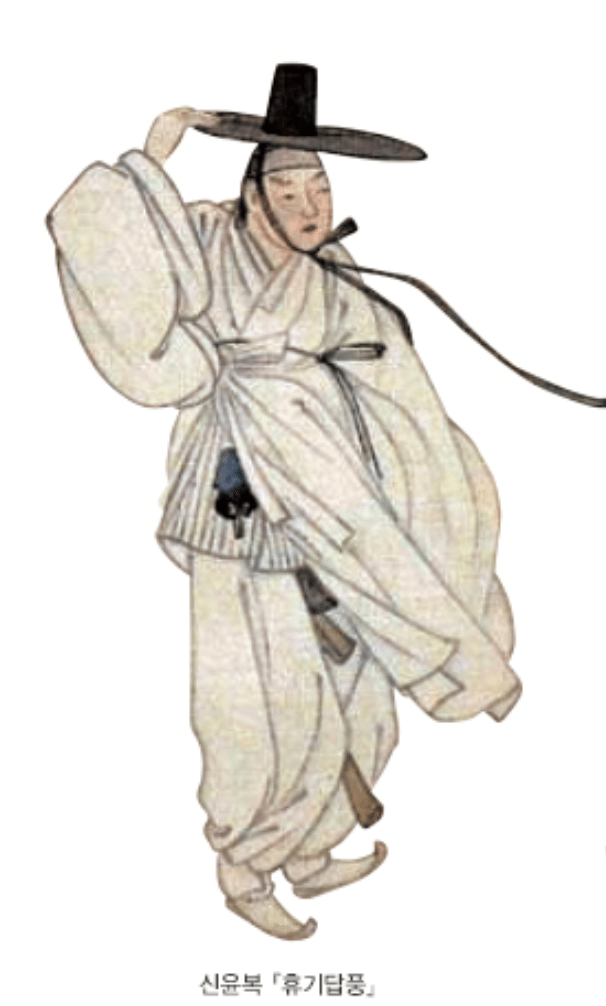
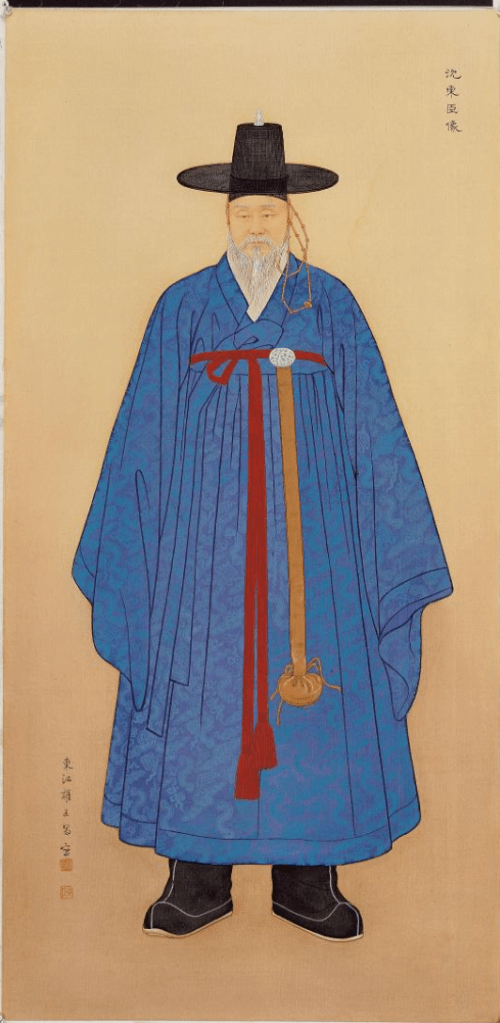
This means that the gat’s design brief included requirements that go beyond comfort and weather protection. The hat needed to signal status at a distance, hold its form through the formalities of a working day, and do so without drawing attention to its own construction — the ideal was a hat that looked effortless while being technically demanding to produce. That combination of social performance and material restraint has parallels in European formal dress history, but the Korean solution — achieving authority through transparency and lightness rather than through volume and weight — is formally distinctive.
The variety within the broader category of Korean traditional headgear is worth acknowledging, because the popular image reduces the full system to a single type. Korean historical scholarship documents hats differentiated by material (silk, rattan, woven bamboo), by form (conical, cylindrical, flat-brimmed), by function (travel, mourning, military, ceremonial), and by region and period. The gat as commonly referenced is one type within a systematic vocabulary of headgear, each with a specific meaning within the social code it participated in.
Why the Gat Attracts Contemporary Attention
Korean historical drama has been the primary route through which the gat has entered global visual culture, and that context has produced some genuine interest in the object alongside the costuming associations. More recently, the hat has appeared in contemporary fashion and branding contexts — sometimes thoughtfully, sometimes as pure silhouette extraction without any engagement with the material or cultural content.
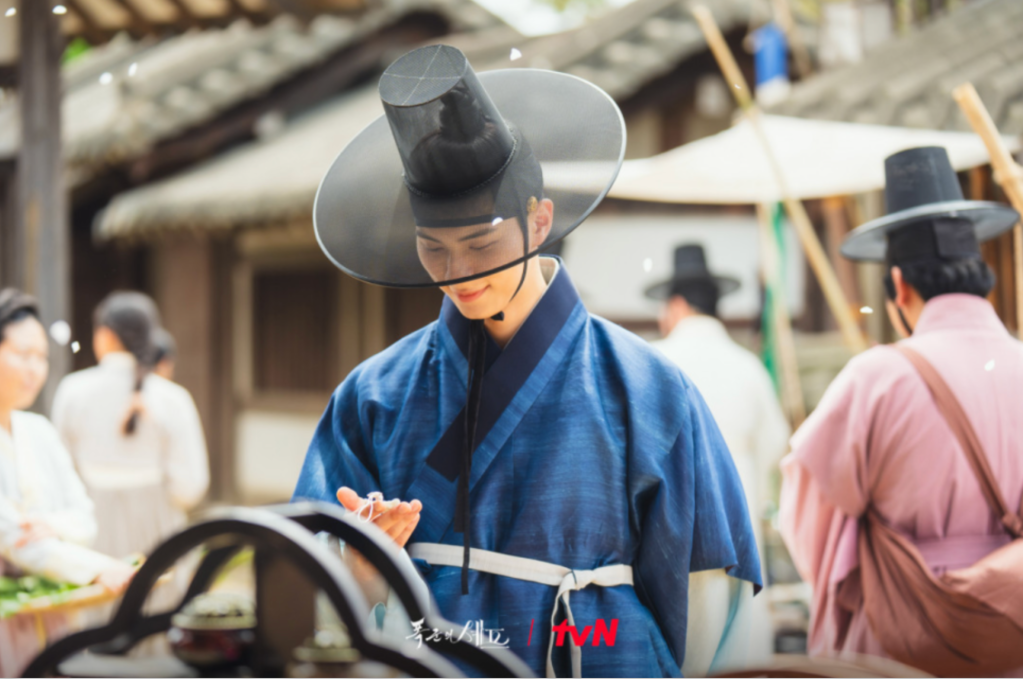
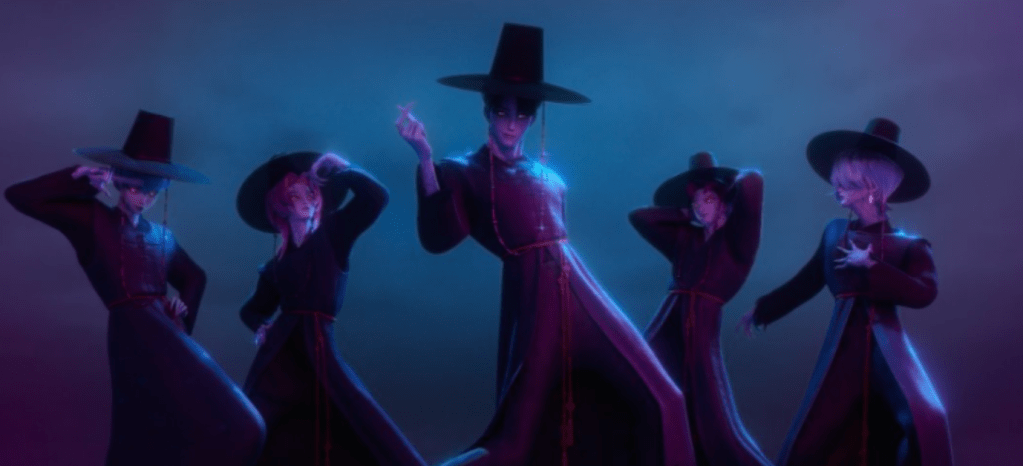
The distinction between those two modes is visible in the objects themselves. Contemporary reinterpretations that engage with the material logic — the transparency, the weight-to-structure ratio, the relationship between brim curve and crown height — tend to produce things that feel related to the original. Reinterpretations that treat the gat as a silhouette (wide brim, cylindrical crown) to be reproduced in unrelated materials produce objects that look like hats. The original is not primarily a shape. It is a material system that produces a particular visual and physical experience, and that system is not easily separated from the materials.
For design researchers interested in the object in its original terms, the British Museum holds a documented example in its Korean collection, and the National Folk Museum of Korea (국립민속박물관) maintains collection materials that address construction and social context in some depth. The video archive of the Korea Heritage Service (국가유산진흥원) includes process documentation of traditional gat-making that shows the component specialisations in practice — the most direct available record of what the making actually looks like.
In this post, I’ll walk you through what a gat is, why it mattered so much in Joseon society, and how traditional artisans still create it today using horsehair, bamboo, silk, and lacquer.
FAQ
– Is a gat always made of horsehair?
Not always. “Gat” can refer broadly to traditional hats, but the iconic Joseon-style gat is widely documented as using horsehair and bamboo, with silk and lacquer used in finishing.
– Why is the black color so important?
The black finish is part of the gat’s formal, refined aesthetic and is often achieved through lacquered finishing processes described in museum documentation.
– What makes a “good” gat visually?
Look for:
- clean symmetry between crown and brim
- a smooth, confident brim curve
- the subtle transparency that looks airy rather than opaque
These are exactly the qualities that require advanced craft control—especially in shaping and finishing.
Sources: National Folk Museum of Korea (NFMK) collection and cultural documentation; Korea Heritage Service (국가유산진흥원) craft archive; British Museum Korean collection object records; Korean Cultural Heritage Administration Intangible Cultural Heritage documentation.

 JJJOZ BLOG
Leave a comment