
There is a moment in the making of a najeon chilgi piece — the traditional Korean craft that combines lacquerware with mother-of-pearl inlay — when the object stops looking like craft and starts looking like something else entirely. The shell fragments catch light at an angle, and what was dark and flat a moment ago appears to have interior depth. That effect is not incidental. It is the entire point of the technique.
Najeon chilgi (나전칠기) is sometimes shortened to jagae in everyday Korean usage. The full term tells you exactly what it is: najeon (나전) refers to mother-of-pearl inlay, and chilgi (칠기) means lacquerware — objects coated in the resin of the lacquer tree (Toxicodendron vernicifluum). The combination of those two materials, layered over a wooden substrate, produces objects that European design audiences tend to encounter in museum cases and promptly underestimate.

Why Wood, Lacquer, and Shell — In That Order
Understanding najeon chilgi starts with understanding what each material is doing structurally, not decoratively.
The wooden base — traditionally paulownia (동백나무) or persimmon, chosen for dimensional stability — provides the form. Lacquer resin, applied in multiple successive coats, provides protection: it is naturally antibacterial, highly durable, and resistant to moisture, heat, and insects in ways that synthetic finishes have only partially replicated. Each lacquer layer must cure under controlled humidity before the next is applied. Rushing the drying distorts the surface. The process has a minimum pace determined by the material itself, not the maker’s schedule.
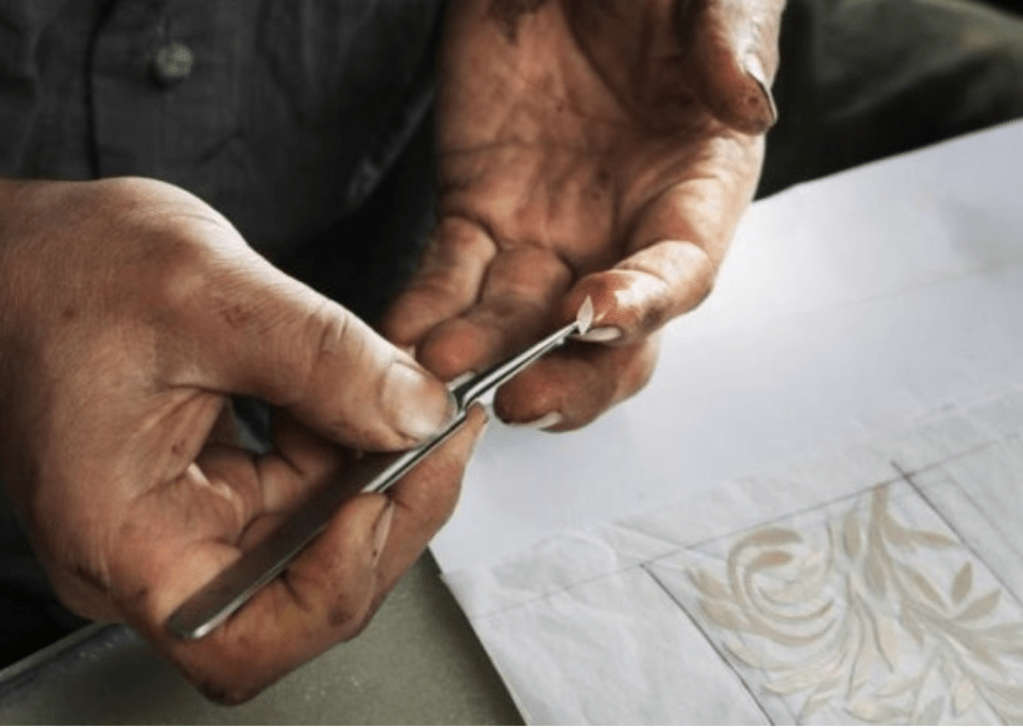
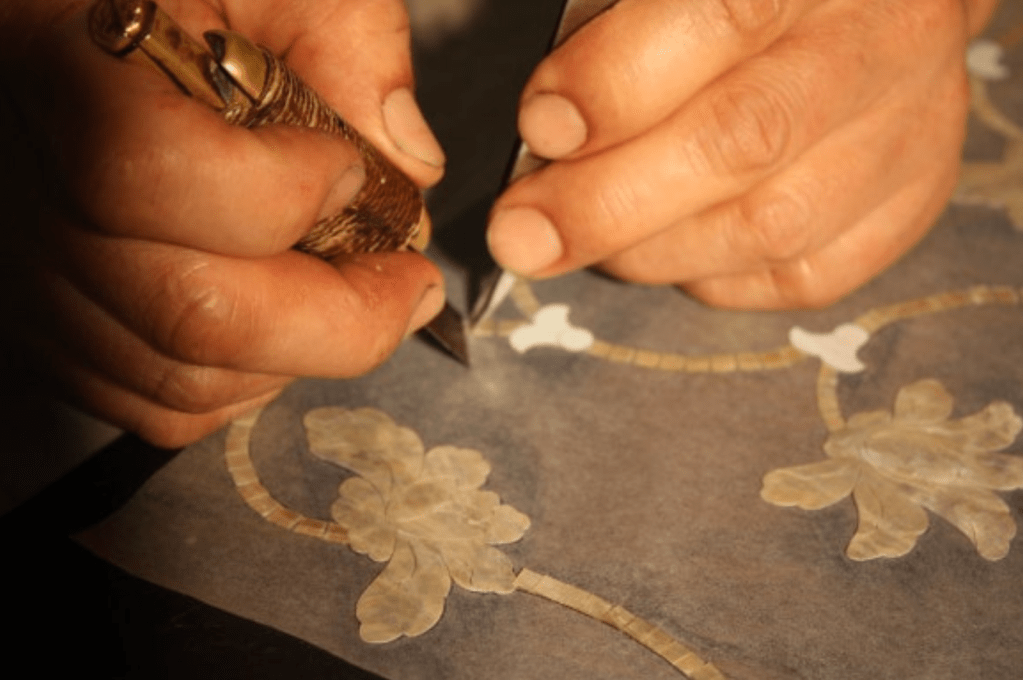
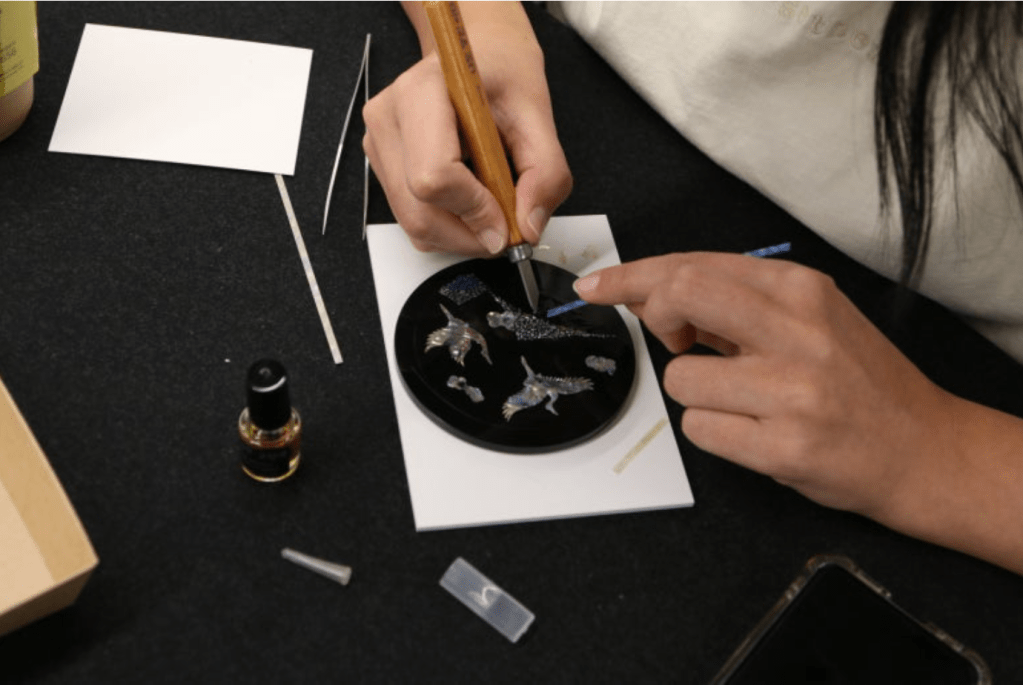
The mother-of-pearl — typically abalone, pearl oyster, or freshwater mussel — comes last, embedded into a still-tacky lacquer layer. Artisans cut shells into thin pieces, then cut those into shapes: geometric fragments, floral outlines, bird forms, interlocking patterns. These are pressed into the lacquer surface and smoothed. Additional lacquer coats follow, sealing the inlay. Final polishing brings the shell’s iridescence back to the surface, now protected within the lacquer body rather than sitting on top of it.
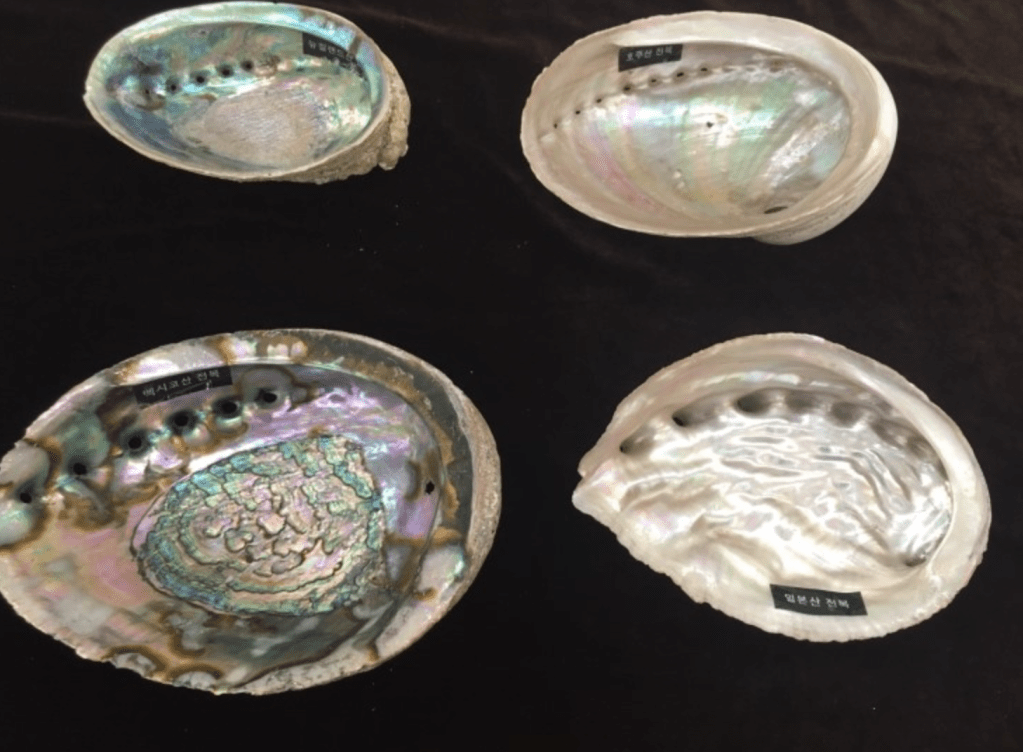
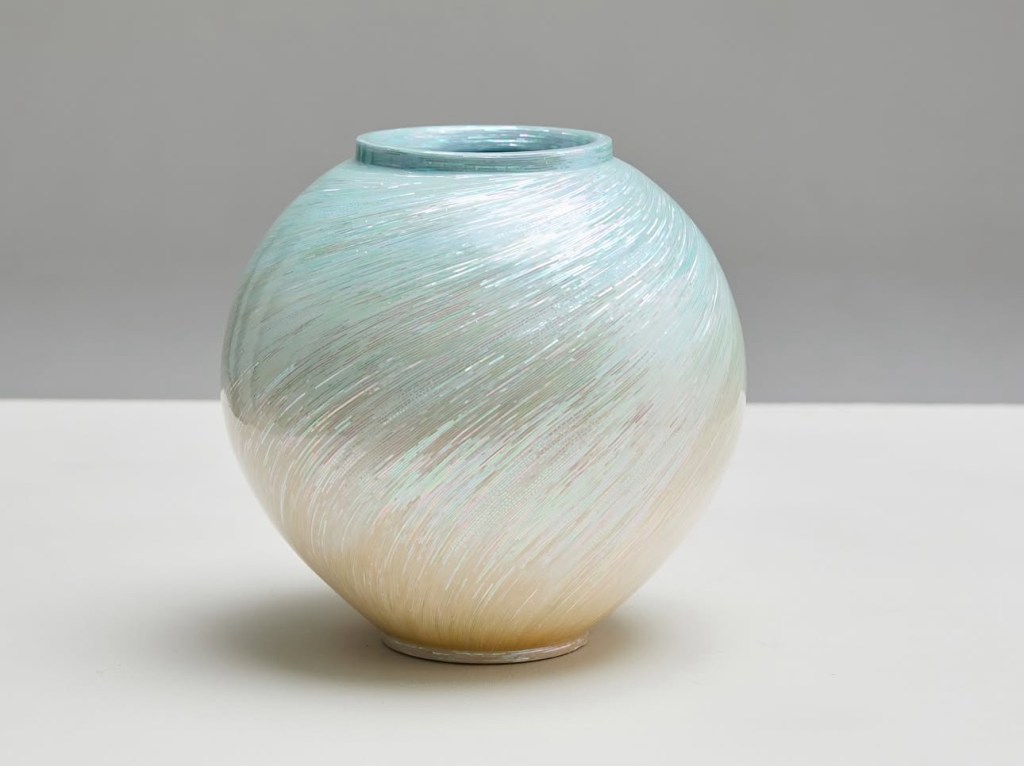
That structure matters. The luminescence of good najeon chilgi is not a surface effect — it comes through depth. Multiple lacquer layers above the shell act as a lens. The angle at which light returns to the eye shifts depending on how thick that lens is, which accounts for the sense of three-dimensional space in a flat surface.
Goryeo to Joseon: What Changes and What Doesn’t
The craft’s documented history runs from the Goryeo Dynasty (918–1392) through the Joseon period (1392–1910) and into the present. Technique transmission from Chinese lacquerware traditions is generally acknowledged in Korean craft scholarship, but the aesthetic divergence is significant enough that comparison obscures more than it reveals.
Goryeo-era najeon chilgi was closely associated with Buddhist objects and royal commissions — sutra boxes, ritual vessels, furniture for court and temple use. The inlay work of this period tends toward dense, fine-line patterns: chrysanthemums, paulownia, vines. Some surviving Goryeo examples held in the National Museum of Korea show inlay work so detailed that the shell pieces measure only a few millimetres across. The technical ambition is easier to appreciate once you understand that this was done without magnification.
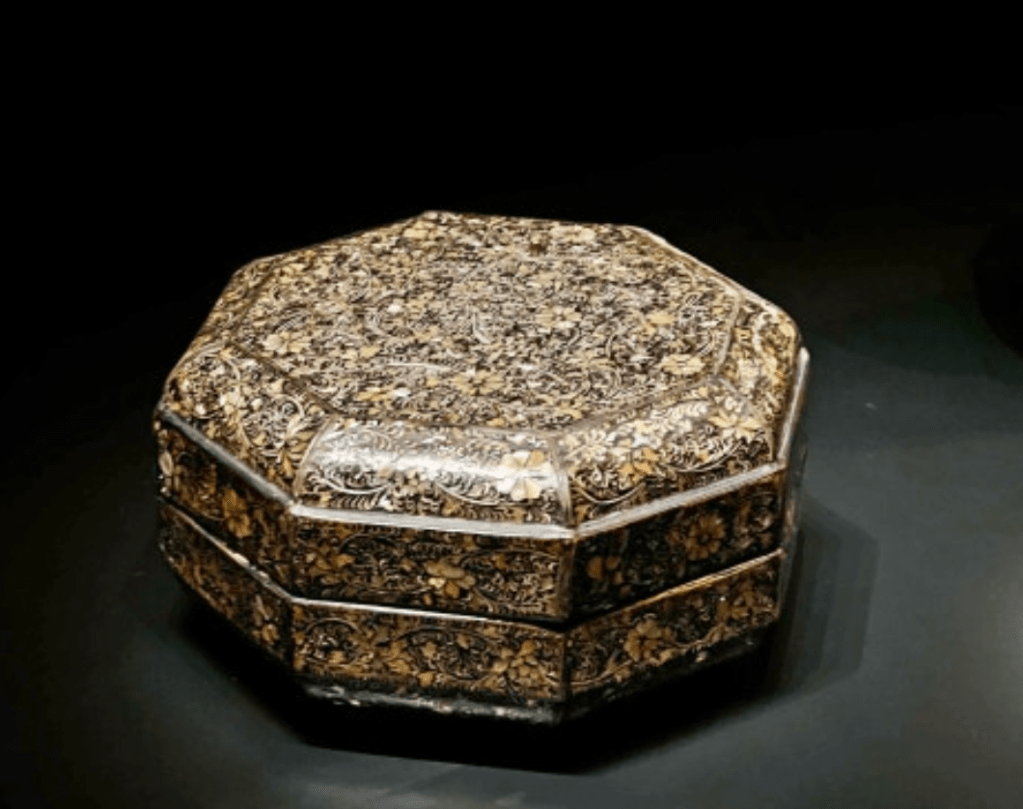
The Joseon period shifted the function of lacquerware objects — away from Buddhist ritual, toward the secular domestic life of the yangban (upper-class) household. Motifs shifted accordingly: less sacred symbolism, more representations of nature, landscape, and flora associated with Neo-Confucian literati values. The objects themselves — small document boxes, stationery sets, cosmetic cases, furniture — were designed for daily use rather than ceremonial display. That shift toward the everyday is one reason Joseon najeon chilgi feels less frozen than Goryeo examples: it was made to be used.
The Colonial Period and the Fragility of Skill Transmission
Any honest account of Korean traditional crafts has to address what happened during the Japanese colonial period (1910–1945). Many craft traditions were significantly disrupted — either suppressed, redirected toward production aligned with Japanese aesthetic preferences, or simply interrupted as master artisans lost the conditions necessary to train successors. Najeon chilgi was not immune to this. The Korean War further broke transmission chains that had already been weakened.
The Korean government’s system of designating Important Intangible Cultural Heritage — and naming individual practitioners as Inganmunhwajae (인간문화재), sometimes translated as “Living National Treasures” — exists partly in response to this history. It is a recognition that certain skills are embodied knowledge: they do not survive in books or documentation alone. They require continuous transfer from a practitioner who has spent years developing bodily competence in the technique to someone willing to spend years developing that same competence.
The designation carries obligations as well as recognition. Holders are expected to train apprentices and contribute to documentation efforts. Whether that system has been sufficient to stabilise the craft’s future is a more complicated question than the designation alone suggests.
What “Contemporary Najeon Chilgi” Actually Means
There are practitioners working today who maintain the full traditional process — wood preparation, successive lacquer application, hand-cut shell inlay, final polishing — and whose work falls squarely within the historical technical vocabulary of the craft. There are others who have introduced synthetic resins or pre-fabricated shell sheets into the process, which is sometimes described as “adaptation” and sometimes as a different thing with a similar name.

The distinction matters for anyone approaching najeon chilgi from a design or materials research perspective. The optical properties that make traditional lacquerware distinctive come from the specific refractive index and layering behaviour of natural urushi lacquer — that is not fully reproducible with synthetic alternatives. If you are looking at a najeon chilgi object and trying to assess what you are seeing, the depth and quality of the light interaction through the surface is the most reliable indicator of the lacquer’s authenticity.
Contemporary applications extend to jewellery, architectural panels, and product design collaborations. The most considered of these take the material’s structural logic — depth through layering, light through opacity — as the starting point, rather than treating the shell inlay as surface decoration available for transfer onto a different object type. When the translation works, it tends to be because the designer understood why the material behaves as it does, not just how it looks.
Where to See the Craft, and What to Look For
The National Museum of Korea holds significant historical examples, including Goryeo-period pieces that allow direct comparison across the tradition’s arc. Seoul’s Craft Museum (서울공예박물관) in Anguk-dong regularly programmes exhibitions featuring both historical objects and contemporary craft work — it is one of the better institutions for understanding how Korean craft practitioners are currently thinking about their own traditions.
For those interested in the process rather than the object, workshop access exists through craft centres and cultural programmes, though the introductory experiences typically focus on basic inlay application rather than the full multi-week lacquer process. That limitation is worth knowing in advance.
The craft’s centre of gravity for production has historically included Tongyeong (통영) in South Gyeongsang Province, which maintains a regional identity closely tied to najeon chilgi and lacquerware production. The city’s craft infrastructure — workshops, training programmes, related cultural institutions — reflects a deeper integration of the craft into local life than is typical of Seoul-based heritage preservation.
[Check Najeonghilgi products on Amazon->]
[Check Jagae DIY Video on Youtube->]
[Check Jagae DIY sticker on Amazon->]
Sources: National Museum of Korea collection documentation; Seoul Museum of Craft Art exhibition archives; Korean government Intangible Cultural Heritage registry (Cultural Heritage Administration). Korean craft history referenced against academic sources held in the Academy of Korean Studies (AKS) database.
 JJJOZ BLOG
Leave a comment